I think I left the teller at the bank genuinely disturbed when I told him that “If I can’t afford it, I just don’t buy it.” “What about a car? Do you drive a car?” he inquired, his voice toning on the edge of fear. I told him, “Yeah, I have a vehicle. I bought it used for under $3,000.” He looked physically pained. “What about if you want to buy some kind of new appliance? Or furniture?” he persisted. I stared at him blankly. “My couch was $5.00 at Goodwill. Like…I just buy shit cheap or I don’t buy it at all. The only thing in my life that I make payments on is my house, my bills, and my insurance, and that’s split five ways because I have housemates.” The young man looked horrified? Appalled? And somehow also awed? This guy couldn’t have been much older than me. But it seemed that he’d never even considered the option before of saving up for something to purchase it outright instead of using a credit card. Am I the only person in my general age group (just turned 26) who’s never owned a credit card, and who has forgone basic comforts in order to save up for items so you don’t owe money to anyone, like, ever?
If you’re living in the US without a credit card at 26, you’re playing with danger.
No credit is viewed as the same as bad credit. Which means you could be denied if you ever do need to rent an apartment or a car. Hospitals and clinics are also less likely to allow payment plan programs for people without good credit.
The best thing you could do at this point is apply for a credit card you’re eligible for and pay a few things (I do gas and groceries myself) with it each month. As long as you keep it to zero balance each month there is no interest and there will be proof of you not having debt (instead of just the absence of debt).
what.
This is legit how it works. The system requires records on you, or else. So you need a credit card and worse, you need to have a record of using it, even if you pay it off every single month. Unfortunately, the formulas used to determine credit score are secret, so we also have people suggesting that your credit rating is helped if every so often you do pay a bit of interest. The whole thing is a complete mess. If you don’t have a credit rating/history, then any loans you manage to get will be at extremely high interest and will require much more effort than they really should.
what
yeaah let me just go get a card that i can’t pay off because capitalism is shit, even if i literally only buy a pack of gum that’d go well
If you pay it off in full every month there is no interest. Do what OP is doing but put some of that on your credit card and pay it off every month, and soon you will have a very good credit rating.
you skipped right the fuck over the “can’t pay it off” part huh
like credit cards are just not a viable thing if you’re poor and have shit income
And I’m saying to literally not put anything on it if you can’t buy it in cash. And I’m aware that they fuck over poor people, but yeah, that’s the system that’s in place. This is advice for navigating it, which is how to obtain good credit which helps a lot.
Right like don’t make minimum payments, put your gas on your credit card then that same day pay the credit card company online then don’t worry about it for another month. It’s an absolutely shit system, but in the event of an emergency it’s good to have.
I have had to explain this to a lot of people in my life, but it’s true- no credit is the same as bad credit. What having (and using) the card actually shows is that you are capable of (and actually follow through on) making regular payments: ie, it is proof of having a steady income (even if you do not actually have a steady income). It is showing you reliably can pay for things you purchase, which is what your credit score is all about.
Think of it this way. You have a credit card, which is your credit tracking device. You use the card to tell someone “I will pay for this thing with borrowed money.” They agree to allow you to pay with borrowed money. You then turn around to your credit card company and say “Thank you for allowing me to borrow your money, I will now pay you back with my own money.” (which, if you repay them promptly enough, you can repay them the exact same amount you borrowed, rather than paying them more than you borrowed [which is what interest is])
The credit card company then recognizes that you successfully borrowed their money AND returned it safely, and they pass that information along to credit tracking companies. Each time you do this, you gain credibility. If you do this enough times, you are considered a credible borrower of money, so that if you ever are in a situation where you need to borrow a large sum of money (for example, a mortgage or a car or a hospital bill or whatever), companies with money will look at how well you have returned money in the past, and say Ah yes, this person repays their debts well, so we can lend them our money this time.
So like, do what the above folks are recommending. Get a credit card and use to to reasonably purchase things you already have to buy- put a batch of groceries on the card. Go home (or wherever you can use the interne), pay it off as if you had paid cash in the store for it. There is no extra fee or interest for doing this, and you are leveling up your credibility in case of emergency later on in life.
Ok, here’s a guide for the easiest way to do this.
1. get your first baby credit card with the bank that you already bank with. If it has cashback rewards, even better (that’ll be free money later).
2. set that shit up so it pays the full amount, automatically, every month. you don’t have to remember to go home and pay it off, or worry about it at all. You won’t pay interest.
Your first card, especially if you have no credit, is going to have a small limit. Like $500. This is important: credit companies want you to use a certain percentage of the card every month. This is 1-9%. I usually just go straight 5%. If you use too much, you look like a wild card (even if you pay it off every month) and if you use nothing than you’re not proving to them you can be trusted.
So your first card has a $500 limit. 5% of 500 is $25.
Your goal is to use $25/month.
This is about a tank of gas for me. So once a month, I would fill up with this card, and then put it in the back of my wallet until next month. The payment was made automatically by my bank from one account (debit) to the other (credit). Rinse and repeat. I did this for a year.
Then after a year, my credit had skyrocketed (because I had nothing before, and added this good habit for a year). So I called up my bank and asked for them to increase my limit based on my new credit. I had shown them I was good at borrowing a good amount of money and paying it back on time every time.
The bank increased my limit to $5,500. Like holy shit, at the time I was definitely not expecting that.
So new math. 5% of 5500 is $225. So now instead of gas, I put my cell phone bill ($50), my car insurance ($130), and my dog food automatic order ($40) on it.
The best part is everything is automatic. I keep this card in the back of my wallet permanently; all these bills and the automatic payments are, well, automatic. My credit goes up, I rack up cash back rewards, there’s nothing to it.
And, if I ever get in an emergency, like a vet bill for one of my dogs, I can use that card to pay the $3,000 emergency bill without worrying about whether the place will take my dog if I have no money. I can then go home, change the settings from “pay in full every month” to “pay $X every month” (more than the minimum!) until it’s paid off, and then go back to just my bills. My credit might take a little dip during that time, but will bounce back pretty quickly.
There’s several other factors to credit (hit me up if you want more info) but this was literally the only measure I took for my first year, and my credit went from 525 to 700 in a year. Another year later, I’m now at 753, have a mortgage with a great rate, and can get a monster ass loan if I really need it in case an emergency or hard times fall.
It’s a shitty system of hoops to jump through, but knowing you can use these measures if it comes to it is a good feeling.
Okay but literally read this entire post please!
Take it from someone who was taught that credit cards are evil, you NEED to build up some credit.
I’m 32 and only JUST NOW able to get a card because my fiance helped me do so. I could not get approved before because I didn’t have any credit.
For those of you who are cardless and now panicking, a few more things:
A credit card isn’t the only way to build up credit.
I’m almost 30 and have never had a credit card in my life. But my credit score is like 730- something.
My saving grace? Student loans. I hate them and they’re an annoying burden, but they build up your credit score. If you pay on time, it adds up.
Also good for credit: renting an apartment and paying rent on time.
If neither of the above are bills you pay, then yes, getting a credit card as described above is probably a good idea.
Honestly, as much as I just don’t trust myself with a credit card, there are definitely times when it would have been very good to have.
Oh, also, medical debt doesn’t impact your score, at least not in the US.
uhHHHH I don’t mean to be dramatic or anything but I literally wrote 50k words in two weeks without fuckening trying,like won NaNoWriMo in 2 weeks,TWO WEEKS, after joining4thewords.comand I’m like
w h a t
OK so it’s pretty much like Neopets + Gaia Online + RPG, But You Level Up Through Writing
You “battle” cute online critters with your word count
You can dress up your avatar and whatnot and there are different regions and crafting quests
and my weird brain apparently responds VERY WELL to nerd gamification
because Holy Shit I wrote 50,600 words in 2 fuckening weeks
and am now 4thewords’ new hype squad
(also if you join, use the referral code PEUOC65061 so if you get a full membership, which I totally am, we will both be rewarded)
basically, wow I have never been this productive in my LIFE and I can’t wait for their July mini nanowrimo event (they’re doing a pride month one right now so you can get a rainbow shirt and fight rainbow beasties it’s freakin adorable)
and if this sounds like something you would enjoy, go for it, try to catch me, just do it, come at me friends let’s write some good shit together
x: a variable used to represent something unknown.
We’ve seen an influx of questions about how to write stories based around characters of color, disability, non-binary, etc. when the author does not fall into these categories. Rather than have these posts take over the site, we’ve decided to compile a list of resources to help our fellow writers become more educated about writing what they do not immediately know. However, this list is not the end-all-be-all of knowledge; one should always try to learn from someone with first hand experience in any topic. The world is constantly growing and changing, and because of that, there will always be more to learn. The admins at Plotline Hotline want to help writers form respectful, informed, and realistic characters that broaden the narrow range we see in literature today.
*Be wary that some of the topics listed below contain sensitive material. Reader discretion is advised.*
As always, the links I found to be especially apt will be in bold. Topics are listed alphabetically, excepting the “other” section.
I hope that this list will provide topics a writer may not initially think to research when writing. If there are any resources that you think would be fitting for this list, please let us know! We want to have as many helpful sources as possible to maximize learning opportunities.
where are those startups that are disrupting the glasses industry
zenni and it’s amazing and i love it 40 dollar bifocals fuck yeah
Hey I’m reblogging this again because if you need glasses here’s what I do:
Go to Costco/Sams Club/WalMart – wherever they’ve got that $58 eye exam. That’s with no insurance, btw. Just $58 cash on the counter, you get your eyes examined.
They’ll give you a copy of your prescription. ASK THE DOCTOR TO MEASURE YOUR PUPIL DISTANCE. If they don’t it’s not a huge deal, you just have to have a ruler around that has millimeters so you can measure it yourself and it won’t be as accurate but being off by as much as a centimeter isn’t a problem.
Make them give you a copy of your prescription – you are allowed to have this, they have to give you it, you don’t have to buy glasses there. If anyone challenges you say you need a copy for your records and you’re not going to buy glasses today.
Go to https://www.zennioptical.com/ and start looking at frames/glasses that you like. If you create an account it’ll let you upload a photo and based on your pupil distance the site will estimate how well various frames will fit you.
Add the frames you like to cart and start checking out – the checkout process will ask you for your RX details that will be written in the boxes on your RX page. It’s pretty intuitive to copy it over but if you get lost use the livechat feature on the zenni page.
Start selecting your glasses details. Your RX will determine what kind of lens you get (go with the one zenni recommends for materials and thickness) but your needs will determine the other stuff. I make sure to get the fancy oleophobic coating because I’m a slimy bog monster. I also get the cheapest pair of sunglasses possible because bog monsters hate the sun. You can get transitions lenses or anti-scratch coating or super lightweight lenses or whatever works best for you. The extras will add up in cost but you gotta do what you gotta do – my life is much better with a pair of sunglasses than it is with some clip-ons for my regular glasses; your life may be better with transitions lenses instead of carrying a second set of glasses. DO WHAT WORKS BEST FOR YOU.
Don’t bother paying the rush shipping, this is going to take two weeks regardless.
GLASSES ARRIVE. WEAR GLASSES.
If the fit isn’t perfect see if the place that did your eye exam will adjust the fit for you. They often will free of charge.
GLASSES. GLASSES. I CAN SEE.
PROGRESSIVE BIFOCALS THAT COST $40 WITH CUTE FRAMES AND NICE COATING.
SUNGLASSES.
FUCK
It costs less for me to get two pairs of bifocals, one tinted and one clear, with special coatings and nice frames than it would cost me to get one pair of single-vision glasses from Warby Parker.
The cheapest frames available for adults on Lenscrafter’s site is $69.95. That is JUST the frames, not the lenses. The lenses are like $200. The anti-glare coating is like $70. THE ANTI GLARE COATING IS FREE AND INCLUDED WITH YOUR PURCHASE AT ZENNI. Just the frames and the coating at lenscrafters costs more than my two pairs of glasses AND my eye exam.
I can’t articulate how many literal headaches Zenni has saved me because I just used to wear my old prescription until I had trouble keeping my eyes open from the strain. Now at the first hint of eye strain it’s like “Not today, Satan!” and I can plan for the $100 expense that’s going to last me potentially years.
Obligatory reminder that a ton of people have added but still, Zenni and other likewise sites (1-800-Contacts) require the prescription be up to date within a year. So yeah plan that in, any time you shop, that script has to be from within the last year.
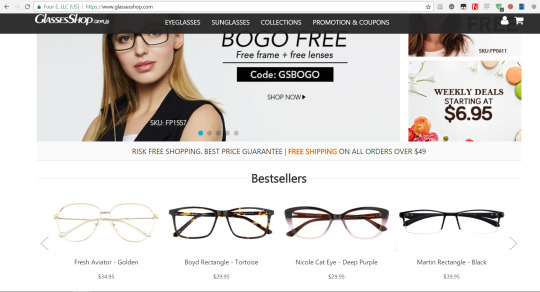
I would also like to submit glassesshop.com because, though I shopped Zenni exclusively from 2012-2017, in the last six months I have gotten four pairs of glasses from GlassesShop, and still paid less than a hundred dollars.
The key difference for me was that while Zenni was utterly eye opening (ha, eye pun), they rarely do sales, and GlassesShop is constantly rolling through a variety of sales. There is almost always a wide selection of glasses on Buy One Get One Free promotion, and the free pair includes the lenses, no matter what add ons are on there or whatever kinda prescription you got, as long as its the less expensive pair.
They also do weekly specials where rotating selections of frames go on clearance-rate pricing, from $6.95-12.95. This is just the tip of the iceberg of the constant variety of sales, promotions, and discounts they offer, and doesn’t include that, also unlike Zenni, if you have an account every purcahse you make accrues points which can be applied in dollar amount to future purchases, even with discounts/sales/promos also applied.
Like Zenni, GlassesShop lets you upload a selfie to “try on” frames you’re interested in, but they have a much wider selection and variety. They take about the same amount of time as Zenni to craft and ship your glasses, and they’re on par as far as quality and accuracy of prescription goes.
I will always be grateful to Zenni for opening the door for me on the online glasses market, because as someone netting less than 20k a year after taxes glasses used to be a “upon pain of death/causing a car accident from blindness” purchase but have become a “well that’s a great sale and I LOVE those frames… I guess I could do with another pair of glasses, there’s $30-50 in my budget!” kind of thing, and that’s incredible.
But I probably won’t be switching back, as after having made multiple purchases, the only thing I like better about Zenni compared to GlassesShop is Zenni has better cleaning cloths.
Regardless, they’re two excellent, amazingly affordable alternatives to spending minimum of $100 at a brick and mortar glasses store, and I’ve turned into something of a proselytizer for both, because people deserve to know they have these options.
It’s bad enough we’re out here paying to see, but too many of us don’t realize we could be paying a lot less to see, and in the cutest glasses best suited to our tastes, instead of whatever’s “cheap” at WalMart.
goggles4u.com is another good site!! they constantly have sales, so you can frequently get glasses for like four dollars plus shipping.
I like eyebuydirect! They have more frame options than zenni, especially for my tiny head lol
So, so many works I’ve read could be vastly improved with tightening and shaving of superfluous words. Wordiness is an easy stumbling block, as we’re used to how we talk. We’re used to how others (long ago) wrote. But times change, my friend, and so do expectations of the writer. We don’t get paid by the word in fiction. So show your smarts and say as much as you can with as much power as you can in as few words as possible.
Here are a few things you can cut without reserve to help shorten your story right now. And as you catch yourself using these words in your next draft, hit that backspace before you finish the sentence! It’s okay if you already have. You can go delete them now. No one will ever know.
Moment/Second/Minute
It’s so tempting. I am guilty of using this word like fertilizer in my first drafts. But most of the time, these words aren’t needed at all. They add nothing.
He sat down for a moment, sipping his coffee. vs. He sat down and sipped at his coffee.
But he only did it for a moment, you say!
He sat down for a moment, sipping his coffee. When the door opened a second later, he shot to his feet. vs. He sat down and sipped his coffee. The door opened, and before he could swallow his first sip, he shot to his feet.
I know, this is about making your writing more concise and my “right” example has more words than the first example. But what’s the difference? The words used in the second sentence are more tangible. They give a visual that “a second later” and “for a moment” don’t. And you could leave that part out, of course, if you’re really going for trimming word count. It doesn’t paint quite the same image, but “The door opened and he shot to his feet.” is a perfectly good sentence.
Suddenly/All of a sudden
You’ve heard this one, before, surely. These words are used…when? When you’re trying to portray suddenness. Surprise, perhaps. So why are you adding in extra words to slow down the pace?
She flipped on the TV and reclined in her chair. All of sudden, the TV flashed a bright light and the power went out. vs. She flipped on the TV and reclined in her chair. The TV flashed once before the lights went dark. The power was out.
That sense of immediacy is felt when stuff just happens. So let it happen. If it’s rhythm you’re worried about, then find more useful words to create the rhythm. Notice that I didn’t just cut “All of a sudden” out of the sentence and leave it. I reworded it a bit to make it stronger.
Finally
It can be a useful word, but more often than not, it’s just taking up space.
“Substitute ’[fucking]’ every time you’re inclined to write ‘very;’ your editor will delete it and the writing will be just as it should be.”
But seriously, if you’re saying, “She was breathing very hard.” You could just cut the “very” and say, “She was breathing hard.” Or, even better, “She was panting.” Or, EVEN BETTER: “She panted.”
Himself/herself/myself/themselves
Reflexive nouns have a specific purpose, though they can still often be avoided. They fall into the category of “use only when it’s confusing otherwise.”
Correct: He looked at himself in the mirror. Better: He looked in the mirror.
Incorrect: She gave them to Andrew and myself before leaving. Correct: She gave them to Andrew and me before leaving.
Technically correct I guess: I haven’t eaten lunch myself. (Intensive pronoun; aka waste of words) Better: I haven’t eaten lunch.
Intensive pronouns add emphasis, but that emphasis is negligible and often negated by the power of tightening your narrative.
That
You can likely cut 60% of your “that"s and your story will be unaffected. Sometimes, you do need to add a “that” here and there for clarification, but not always. And sometimes it’s just plain incorrect.
The jacket was the coolest one that he’d ever owned. vs. The jacket was the coolest one he’d ever owned.
In other cases, you might do well to substitute “that” with “which.” Though, if you’re doing this, make sure you do it properly. That change can often alter the meaning of your sentence. That can be for the better, though.
The vandalism that read “Bad Wolf” made Rose nervous. vs. The vandalism, which read “Bad Wolf,” made Rose nervous.
Do you see the difference? In the first sentence, the words are what make Rose nervous. In the second, the vandalism itself makes Rose nervous, and it happens to say “Bad Wolf.” In this case, if you’ve watched Doctor Who, then you know the first example is the correct one.
So when you’re sharing details using “that” or “which,” contemplate how important they are to meaning of the sentence to determine which type of clause you need to use.
Then
Or worse, “And then.”
It makes your writing sound a bit juvenile. Either cut it entirely, or substitute “and.”
She jumped into the pool, then hit her head on the bottom. vs. She jumped into the pool and hit her head on the bottom.
And then, after all that time, she fell asleep. vs. After all that time, she fell asleep.
Even
Sometime “even” can help emphasize a situation or behavior, but when it’s used in narrative improperly, it sounds childish and silly.
He couldn’t even breathe. vs. He couldn’t breathe.
Even with the new hair gel, his hair was terrible. (This one is fine, though you could still cut that “even” if you really wanted to…)
Just
Just…Delete it.
Breathe/breath/exhale/inhale/sigh/nod/shrug
Another one I’m so guilty of. In my first drafts, I tend to talk about how a character is breathing, or when they’re sighing like nobody’s business. I know a lot of writers who are guilty of this, too. It’s a great tool to use scarcely. In intense moments, you can let your character take a final deep breath to calm themselves. When a character almost drowns, those first few sweet breaths are important. But you readers know that people breath all the time. And just because you need a beat in your dialogue doesn’t mean you need to remind your reader that the character is still breathing or moving.
Rather/quite/somewhat
She was rather tall. She was tall. He was quite idiotic. He was idiotic. They were somewhat snazzy. They were snazzy. Why do you need those words? Kill ‘em.
Start/begin
This is a great example of fluff.
She started to run toward the shop. vs. She ran toward the shop.
He began scolding them for their performance. vs. He scolded them for their performance.
There are obviously uses for this word, like anything. He started the car. Begin your tests! But when you’re using it to slow the action and the pace of your narrative, then consider heavily if you need it. You probably don’t.
In order to/in an attempt to
Phrases that add unneeded complications, cumbersome wording…kill ‘em!
She bit down in an attempt to stop herself from screaming. vs. She bit down to stop herself from screaming.
Was able to
He was able to call. vs. He could call. OR He called.
This is one that isn’t inherently bad, but it can easily be overused and cutting it will help simplify your narrative.
Due to
Ugh. Are you trying to sound proper and stuffy? Because that’s a reason, I guess, to use this phrase…and yet it sounds like doodoo. (Yes. I’m an adult.) Rephrase. Use “Because of” or just avoid the need altogether.
We stopped due to traffic. vs. We stopped because of traffic. OR (Strength of narrative!) We stopped mid-highway. The parked cars went on beyond the curve of the road, out of sight.
Visibly/obviously/apparently/audibly
These are a sign of telling in your narrative when you should probably be showing.
She was visibly shaking. –> She shivered, hugging her upper arms. He was obviously tired. –> He yawned and tripped on his own feet as he crossed the room. They were apparently angry. –> They stomped and shouted, demanding attention. She screamed audibly. (Really?) –> She screamed.
Don’t tell your readers what emotion a character is feeling. Instead, give a few clues that they can see/hear/feel the emotion too.
While
This word has lots of legitimate uses. However, if you’re using it poorly, then your narrative reads like an Early Reader’s book, and you (unless that’s what you’re writing) probably don’t want that.
“Get it together,” he said while flipping them off. vs. “Get it together,” he said, flipping them off.
Turned
One of the classics. So overused, my friends. It’s needed on occasion, but not nearly as often as we use it. Just cut it out.
They turned toward her as they spoke. vs. They gave her their full attention as they spoke. OR They looked into her eyes. OR (Nothing. Readers don’t have to be updated on every little movement.)
Saw/looked/regarded
UGH. Regarded:Looked::Mentioned:Said
And, like “said,” many, many instances of these words can be nixed.
She saw them run for the hills. vs. They ran for the hills.
This can be tricky, I know, when you’re writing in limited-third or first POV. It’s tempting to put every action directly through your POV character’s filter. But resist that temptation! There are times when it’s appropriate, occasionally, but it can be overdone so easily.
I looked at her and said, “Please.” vs. I said,“ Please.” OR. I took her hand. “Please.”
This example sides with the breathing and the turning. It’s often an unneeded update on the tiny movements of the characters. And, again, sometimes you need that beat or that little detail in an intense moment, but not often.
I’m not here to tell you to cut all your dialogue tags (please don’t). I’m also going to the last person who insists you get rid of “said.” In fact, I’m in the “said is invisible” party of writing nerds and I think, if you’re going to use a standard tag, it should be “said” 90% of the time.
But aside from that, using as few dialogue tags as possible is a good thing. I’ll do a full post on this soon, but for now, be aware of how often you rely on these words in your dialogue and do your best not to overuse them. Use surrounding action and context to take some of the reliance off of these words.
To-Be in all its conjugated forms
If you’re using any of this list:
am, is, are, was, were, be, being, had been
Then check yo’self. Some tenses call for an auxiliary verb. Some types of sentence do, too, not doubt about it. But many don’t, and cutting to-be verbs when you can will help tighten your writing.
We were going to the store. vs. We went to the store.
Sounds were echoing through the chamber. vs. Sounds echoed through the chamber.
To-be verbs can also be an indicator of passive voice, though they aren’t always.
He was hit by the ball. vs. The ball hit him.
Last but not least, check all of your adverbs.
Chances are, if you’re using an adverb, you could be using a single strong verb instead and giving each sentence more punch.
He ran quickly. –> He sprinted. I hit him hard. –> I socked him. She spoke quietly. –> She whispered. They ran into each other fast. –> They crashed.
So what am I supposed to do about this?
Take it to heart. Try not to let these words take over your brain as you write. Once your manuscript is finished, try this method:
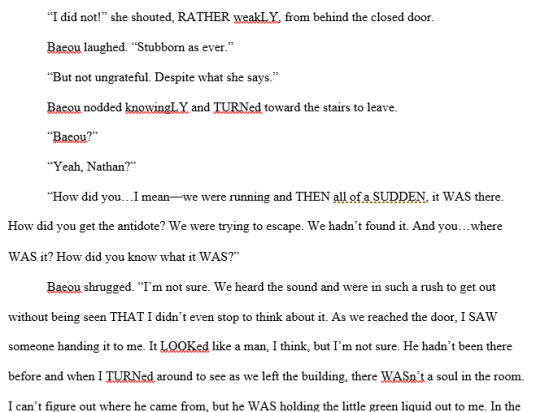
Use Find and Replace. Replace any and all of the aforementioned words in ALL-CAPS. Now, if you’ve paid attention to my advice in using emphasis, then those all-caps will really stick out as you’re reading over your work and you can decide at each instance whether your usage is appropriate, or if it needs to be rewritten. As I did to this very old draft of mine from my first NaNoWriMo (in which I used every single word on this list, I’m sure).
When I used this method with my most recent WIP, I was able to cut my word count from 105k to 93k without cutting any content whatsoever. It takes a lot of work and it’s pretty tedious but the results are amazing!
It wouldn’t be the English language without exceptions, would it?
Now, there is actually an important time for intentionally using any or all of the words on this list. You know when that is?
When it fits the character’s voice. – More on this in my next post!
Hey guys! As a writer myself, it’s hard to have a lot of resources for writing in one place. That’s why I decided to create this masterpost, and maybe make more if I find future resources. I hope you like it, and expect to see more masterposts like this in the future!
ZenPen: A minimalist writing website to keep you free of distractions and in the flow.
The Most Dangerous Writing App: A website where you have to keep typing or all of your writing will be lost. It helps you keep writing…kind of. You can choose between a time or word count limit!
Evernote: An online website where you can take notes and save the product to your laptop and/or smartphone!
Writer, the Internet Typewriter: It’s just you and your writing, and you can save your product on the website if you create an account.
Wordcounter: A website to help check your word and character count, and shows words you’re using frequently.
Monospace: An Android app for writing on the go when you feel the inspiration, but you don’t have your laptop on you!
For Productivity
Tide: An app that combines a pomodoro-esque timer with nature sounds and other noises! (Google Play / Apple Store)
ClearFocus: An Android app with a pomodoro-type time counter to let you concentrate easier and stay productive.
Forest: An app with a time counter to keep you focused and off your phone, and when you complete the time limit, a tree grows in your garden! (Google Play / Apple Store)
SelfControl: A Mac downloadable app that blocks you from distracting mail servers, websites, and other things!
Tolkien’s world is super complex and The Lord of the Rings + The Hobbit is just a fraction of Middle Earth’s history and its mythology. And Tolkien is not just Middle Earth! He has written stories that don’t take place in Middle Earth.
I really have no idea where to start, but I guess since you’re like completely new to this whole world, I suggest you start off by watching the movies. Just to get an idea of what you’re about to get into.
And to avoid too much confusion, you should watch them in chronological order.
MOVIES
The Hobbit – An Unexpected Journey
The Hobbit – The Desolation of Smaug
The Hobbit – The Battle of the Five Armies
The Lord of the Rings – Fellowship of the Ring
The Lord of the Rings – The Two Towers
The Lord of the Rings – The Return of the King
Keep in mind, they were not filmed in that order! Lord of the Rings was filmed ten years before The Hobbit. But I think it just makes sense to watch them in that order so understand the storyline better.
There’s an extended edition of every movie (except for The Battle of the Five Armies, which will be released later this year) and most people will tell you that the movies are a lot more fun and interesting if you watch the extended editions. But they’re super long! Like, really freaking long. I mean if you’re up for 12 hours of move material and 40+ hours of Behind-The-Scenes material, go ahead! But I started off by just watching the theatrical versions.
BOOKS
Okay, you know that the movies are based on books, that’s good! And I think once you’ve watched the movies, you should also read the books. But don’t be surprised: Sometimes movie and book are two completely different things, especially The Hobbit. Like, you will literally find yourself thinking “what the hell, this is really the same story????!!!” So, yeah. Just a warning.
You can find pretty much all of Tolkien’s works online.
What? The Hobbit is just one book? Yeah, that’s correct. Again, two completely different things!
Okay, so you’re covered for The Hobbit & The Lord of the Rings, which are obviously Tolkien’s most famous stories with the widest fanbase.
But, there’s a lot more to read about Middle Earth! Ready for a shit on of Middle Earth history? Here we go!
The Silmarillion
A collection of stories about The First Age (Lord of the Rings and The Hobbit take place during The Third Age), published and partly written by Tolkien’s son Christopher. It really is a must-read for Tolkien fans! It really describes the universe in which the stories take place and at times it can be a bit confusing because there’re so many characters and races and places and wars.
And the fandom has even provided us with a hella cool reader’s guide, which is a cool thing to keep up with the story and all the long-haired and beautiful elves.
So, that’s The Silmarillion. If you’re wondering if there’s gonna be a Silmarillion movie, the answer to that right now is no. But you never know.
Unfinished Tales
Again, written by Christopher Tolkien. As the title suggests, this is a collection of ‘expanded’ stories from The Silmarillion, The Hobbit & Lord of the Rings. It’s mostly longer versions of certain chapters or stories. Definitely not as hard to read as The Silmarillion, since you already know all the characters and storylines!
Okay, once you’ve come this far, it’s time to step up the nerd level a little bit.
The History of Middle-Earth
Okay. Okay, now take a deep breath, because shit’s about to get real. Because The History of Middle-Earth is a 13-volume series of books! Basically it collects and analyses every piece of material that is related to Middle-Earth. There’s stuff like early versions of already published works but also completely new material!
These books are so freaking detailed, because Christopher Tolkien literally analysed every single footnote and every small bit of information that his father had written down. This is all the mythology, you guys!
I cannot give you a summary or overview of every single book, because by now they have kind of converted themselves into this massive box that is titled “Middle Earth nerd trash stuff” in my brain. I’m sorry!
Congratulations! That’s about it for the mythology. But we’re far from done here. There’s more!
But so far, all of the books I have listed should be read in that order! Just to make things easier for you. Anyway, there’re a few more books, but it doesn’t really matter when you read them, because some of them are stories on their own, some are only loosely connected to The Lord of The Rings or The Hobbit and some of them are just collections of poems, not really story-related at all.
So, here we go!
The Adventures of Tom Bombadil
Basically just a collection of poetry. Beautiful poetry! These poems are loosely connected to the events of The Lord of the Rings, but don’t contribute anything to the story.
So freaking interesting! A collection of letters written by the professor to his wife Edith, his friend C.S Lewis, his son and many other. Most of them discussing his stories.
A poem sung by Bilbo at the Grey Havens as he is about to leave Middle-Earth forever. So chronologically it takes place at the and of The Return of the King, but it was never included in the book.
Couldn’t find a link anywhere!
The Children of Húrin
A more detailed version one of the Three Great Tales in The Silmarillion.
That’s about it. It took me about five years to read and understand all of this. So, good luck my friend!
WEBSITES
There’re so many websites dedicated to Tolkien and his characters and languages! If you ever feel like looking up some random stuff or learning more about certain things, here’s a good list of interesting websites!
Okay, I’m spent! That’s literally all of the information and resources I could dig up. Should last you for a bit, I think!
If you ever have any questions about Tolkien, feel free to ask me! Because I do think that I know quite a bit, even though I’m still far from being an expert! So far from it!
So you have a set of characters ready for the curtain to rise and the story to begin. But how do they get along with each other? Do they even get along at all?
Character relationships are REALLY hard to do. But character webs have helped me keep track of how everybody relates to one another. They’re a way to visually connect characters to help you remember what they think of each other.
They end up looking something like this:
And honestly? They’re just as cool as they look. Let’s go through a quick rundown of how they work.




 willowfoot