So, after having tried my hand at a timeline of the BBC Sherlock series, I’ve recently put myself at a much more complicate and ambitious task – that is, a chronology of the original ACD’s Canon.
Of course, any attempt at such an enterprise is an hazard, as we know how sloppy Doyle could be with dates and other chronological details…
And this is, naturally, only my PERSONAL timeline: I intentionally avoided to go back to my Baring-Gould or other chronologies, compiled by other people, so as not being influenced.
Some brief clarifications, before I leave this post open to asks and replies:
I found myself forced to anticipate what I thought to be Sherlock Holmes’ birthdate: I noticed that, in GLOR, it’s said that the Gloria Scott sunk in 1855, and thus Victor Trevor could hardly be born before the end of 1957; but Holmes and Trevor were fellow students at college, so Holmes must be born in 1857, too. This, however, would also be congruent with what Watson tells us in VEIL about the duration of Holmes’ career and of their active cooperation.
I inserted a specific note about the controversial question of the date and duration of Watson’s first marriage. Here we have TWO thorny issues to handle: 1) From SIGN it would seem that Watson and Mary Morstan got engaged and then married in 1888, but from many hints in other stories (mainly NOBL, SCAN and FIVE) it appears more likely that all the events portrayed in SIGN – thus including Watson’s engagement and, possibly, his marriage – actually happened one year before, in 1887; if this were true, many of the cases I placed in 1889 could instead have occurred in 1888. 2) Through all the years 1889 and 1890 Watson appears alternatively to live with his wife and be in practice, and to live in Baker Street with Holmes; this is the main reason why some scholars have hypotesized that Watson’s marriage with Mary Morstan only lasted some few months, and Watson then married ANOTHER woman before 1891; I, however, cannot agree with this theory, as the periods of lodge-sharing and those of matrimonial life appear completely intermingled between 1889 and 1890: my take on it is that Mary’s health deteriorated quite soon after her marriage and she was frequently absent, to a sanatorium, or an asylum, or on trips in more salubrious places than London; another possibility (which I’ve already stated), which is linked to the fact that Holmes and Watson, in VALL, appear aware of the existance and crimes of Moriarty much before 1891, is that Watson actually kept Mary away most of the time during the years in which Holmes and him investigated Moriarty’s organization, in order to keep her safe from possible threats.
And now I’ll leave this open for comments and further speculation on your part.
THAT FIRST SITE IS EVERY WRITER’S DREAM DO YOU KNOW HOW MANY TIMES I’VE TRIED WRITING SOMETHING AND THOUGHT GOD DAMN IS THERE A SPECIFIC WORD FOR WHAT I’M USING TWO SENTENCES TO DESCRIBE AND JUST GETTING A BUNCH OF SHIT GOOGLE RESULTS
HOW TO WRITE 20 PAGES (from one girl w/mental illness 2 the rest of u, but please keep in mind all of this is just personal Stuff That Worked for me n u might be different):
first of all, and probably most importantly, make that paper about something you actually give a shit about. if you can write an essay on how long shakespeare’s dick is when you’re talking to your friends, that’s a good topic. don’t choose something u don’t care about, you will Want To Die
“okay but the only topics are ones i don’t care about” talk 2 ur teacher 99% of the time if you’re like “here’s a well-thought-out thesis can i talk about this instead” they’re like “sure lmao i just couldn’t think of other paper topics to suggest”
“they said no” cool find the one u hate the least and try to tie it into something u like. for example i really hated this stupid paper i had to write about a stupid book so i ended up writing about the food inside the book and whether or not it was a historically accurate depiction of food. turns out i fucking love talking about food. i also remade some of the old recipes and brought them in as part of the presentation of my project and people went fuckken nuts bc BREAD. basically i thought about “what motivates me? uh food” and followed that. it was a 45-page book about bread and i looked like a really good student when really i just love bread (somewhere, oprah smiles over me)
the 20-pagers are the ones you Actually Cannot Do the night before. i know we all got real fuckken cocky back in hs when we learned how to do 5 pages in one night w/out trying too hard but 1. as a teacher now i can tell u for sure that teachers do know you rushed it, we just Don’t Care bc We’re Not Paid Enough and 2. twenty pages is not the same thing. you need to actually take the time to do it. this is the actual version of “you’re not in hs anymore” DONT lie to yourself and think “it’s fine i’ll do it in one day” you will !! Regret it!!!!
“raquel. raquel. listen to me. do you actually believe i’m capable of time management. raquel i have depression i barely manage to exist.” same. but the truth is that when i started like?? actually following the rules of timelines and taking my time etc it actually really helps mental illness. you don’t feel pressured all the time by a deadline, so your anxiety chills a little bit. small progress being acceptable means that on depression days, you don’t have to worry you’re fucking it all up. when it’s 15 minutes every day (even if it’s only 1 word a day) it feels a lot better.
ask the teacher what timeline they’d recommend. they actually Know.
always ask if it’s informal or formal (if you can use “I” statements or not). informal essays can rely on personal feelings and are so much easier and trust me if you find out on the day it’s due that you could have written 12 pages about your feelings instead of 12 pages of research, you will Be Very Upset
i lie to myself all the time and move the deadline up. i write it in my agenda as at least 2 days before it’s due. surprise!!! i tricked u, self!!! you can’t procrastinate!!
agendas/planners need to be what actually works for you. i liked to prioritize w/colors + keep lists. i really love crossing things off lists. it’s like… a balm. for me, i usually say i have to finish the first 2 things, start the 3rd thing, and “touch” at least half the list. if i finish the whole list i get a prize. also i get to cross off everything which is so satisfying i’m sure it’s someone’s idea of a rush. there’s so many “how to” documents on these that i won’t get into it but frankly?? if you don’t write it down you will not remember it. “yes i will” no you won’t greg. just do it. write it down. write it where u can see it. not there, greg. greg, somewhere good.my friend is smart af and uses a post-it on her laptop. that doesn’t work for me bc i can just? use my hand to cover the anxiety? so choose somewhere good greg.
nervous system, skeleton, meat, skin. nervous system is the thesis. skeleton is quotes/data. meat is the analysis of that data. skin is the fancy transitions + beautification. meat goes on both sides of bone, and skin goes all around. nervous system has to touch everything. do what your teachers have been begging u to do since 3rd grade and start w/an outline. do this while you read/research. i usually have a starter thesis like “lady macbeth is a feminist ICON” then take the quotes i think fit. but if while you’re reading u realize u wanna talk about the use of feminine language and how shakespeare parallels daintiness w/sharpness, u still have a bunch of quotes you can use or not use. this works also w/research papers. just pull what u think is something u wanna talk about. copy-paste it but leave a link to where u got it. then put a bullet point under that says roughly why u mention it
if you just write the outline like you’re keeping notes to yourself you’d be amazed how quickly you write the essay bc we get stuck in academic language but it’s easier to translate “this is why bees are the #bomb” into a paragraph. i mean you just rewrite your notes to yourself in academic speech. “The above passage illustrates the growing necessity of pollinators such as bees in an agricultural environment.”
keep track of your sources + label them. don’t just write “(SOURCE)” instead if you’re using multiple sources use the lazygirl way which is (SA1) or whatever shorthand u have for each source. then when you need to finish your sources you go to your little source document, find the one labelled SA1 and then “Find+replace” w/the actual source.
integrate quotes so it reads w/clarity which means don’t do this but if you’re running late on it and don’t have time to look up the quote u want to fit this situation, technically you can “use any” word you want (56). so yeah “there is” a moral question about it but you “can” make up quotes (79, 90). don’t “actually” do this unless you’re seriously in a crunch. which u shouldn’t be, bc u managed ur time, right?
running late part 2 (which again would never happen bc you followed my advice and made a little time table for yourself but anyway if it does somehow magically happen) i really recommend using school computers to do your work. ur surrounded by people who will hold u accountable + u will focus
running late pt3 on the day of it being due, around 5 PM, be honest w/yourself and see where you are. if you’re like “it needs 2 more hours” okay. but if you’re like “this is……… not started” email the teacher. they’ll be so much more receptive the earlier you do this in the process. it looks like “i’m genuinely struggling and i hope to finish this on time but i’m worried i won’t” instead of “i started this at 11:58PM and am asking for an extension”. please also just… be honest?
“my teacher won’t accept late work!” they all say that, he probably will, particularly if you have a note from the school therapist being like “lmao she’s got so many mental illnesses idek how to help her”
“no he really doesn’t, he doesn’t care” you can file for disability if you have mental illness, and, in fact, you should if it’s something that often stops you from completing work on time. i didn’t bc i found that it just let me procrastinate for a longer time, but having that on file means you can go to the dean.
“no!!! raquel you’re not listening i have 2 pages and he doesn’t take late work!!!!!!!!!” okay. yeah that’s bad. but nerves, skeleton, meat, skin. what is it that you’re struggling with? is it that your can’t find any quotes to back up your thesis? impossible, tbh, you need to be more willing to purposefully misuse quotes (don’t do that). but the better option is to just change the thesis.
“i don’t even have that!!” did you. do the reading? if you even just watched the movie, you probably have an opinion on something even if it’s “this is bad.” you can use that. use why you didn’t like it to write a hate-fueled examination on how whiny the main character is and why u think the author is trying to point out how miserable cis white boys are to deal with.
“i don’t have enough sources!!!” go to wikipedia’s page about it and look @ the sources. try to like actually read some if you have time but frankly in a hurry a student (me) might be compelled to just slap the source in there.
“how the fuck do i analyze this”. u know how ppl agonize over why an actor breathed in a scene. melt into that kind of thinking. you can literally force the words to mean whatever you want. i’ve talked about word choice so specific that i based a 12-page essay on three separate uses of the words “my dear”. i talked about the possessive “my” and how it developed for like 5 of those pages. and always repeat the thesis like a million times. after every analysis you should talk about how it links to the thesis. that is like a free 3 sentences every paragraph.
“i did all that and it’s still 3 pages too short” quick ways to Beef Him Up: definitions are great in research papers + essays bc you can talk about either word choice or like the definition of every process used in getting the data. also make the conclusion hella informative (it should answer “what does this mean moving forwards” most of the time, tie it into modern life or into the past). thicken ur intro with “here’s a quote from this guy about it and what he personally felt about acid-base titrations”, use a paragraph to talk about the history of the data/book, use a paragraph to talk about the modern reception of the data/book. also look for where you can use two words instead of one even tho like grammatically don’t do that.
worst comes to worst, brevity is the soul of wit. most teachers prefer concise over rambling and all over the place. if you choose to scoot under the page limit, tho, your writing etc needs to be exceptionally clean. frankly i’ve only done this once and it was terrifying
make computer read it aloud 2 u before u submit. “raquel….. i can’t look at it anymore”. you’re not looking @ it, you’re discovering you wrote “breath” not “breathe” and u need to change it
tutoring centers exist, i worked in one, and this is how i know they actually Help and have Good Ideas
ask about extra credit and do it tbh
good luck…. breathe. and remember u are astronomically more important than a grade could ever be.
As an apartment dweller, this is a game changer. My current apartment doesn’t have a laundry facility and the closest Laundromat about a 30 min bus ride which is just not practical. The mini-washer is a life saver
The panda mini washer hooks up to the sink, is incredibly lightweight (about 28 pounds, so light even I can lift it) and easy to use.
It has a surprisingly large capacity. The basket from the first picture represents about one and a half loads. The jeans took up a whole load while the rest filled the bin only half way.
Here’s the inside. The left is the washer the right is the spin dryer. Yes, it even drys.
Basically you shove your cloths into the washer, fill it up with water and let it go. I use my shower head to fill it up so it goes faster, the sink hook up took about five minutes to fill the whole tub, with the shower head is is down to a minute an a half. I do it in three wash cycles, a five minute rinse with baking soda, a five minute wash with soap and a three minute rinse with water. You have to drain and refill between each cycle so it’s a little more labor intensive than a traditional washer.
That’s the spin dryer. It’s about half the capacity of the washer so one wash takes about two loads to dry. The spinner is much more effective than I was expecting. A three minute spin gets my cloths about 90% dry. I hang them up to air dry for that last 10%.
The machine cost me about 150$. When you factor in two dollars for the bus, five for the machines (per week), the mini-washer pays for its self after only about six months worth of laundry.
I’m not great at expressing emotion, but I’m hoping you can tell how excited I am. Let me just say that the panda mini-washer is great and I highly recommend it to anyone currently using a Laundromat.
Read this and immediately bought it on Amazon for $180. I spend $15 a week to have my laundry done so this pays for itself in 3 months for me. THANK YOU JESUS.
OMG
@ all my nyc pendejas
Oh by the way, they have table top dishwashers that are pretty much the same thing:
This is one of the biggest technological breakthroughs for the everyday homeowner in the current decade: the realization that refrigerators aren’t the only things that can be miniaturized for better affordability and minimal space requirements.
Can you IMAGINE how this is going to change the lives of college students and apartment-dwellers? Or anyone with a lower income who can’t afford a place with “luxury” appliances like dishwashers and laundry machines?
V.E. Schwab writes genuine characters and weaves a fantastic story filled with magic. It’s the second book that really brings out the LQBTQ+ relationship. I would recommend ADSOM to anyone who loves Harry Potter (and was pissed by lack of representation), or to anyone who loves magic, portal fantasies, or parallel worlds.
Carry On by Rainbow Rowell
Once again, if you love Harry Potter, you’ll LOVE this, and if you didn’t love Harry Potter you still might. This book is the best of contemporary relationships, magical schools, and parlous adventures.
Six of Crows duology by Leigh Bardugo
Do you like heists? Do you like morally ambiguous characters and antiheroes? If so, you’ll like this book.
Every Heart a Doorway by Seanan McGuire
What happens when children come back to the real world after the portal fantasy ends? Every bit as magical and whimsical as the portal fantasy stories.
Most of these are pretty popular, but I’m always surprised in my real life how few people have read them.
These LGBTQ+ characters aren’t defined by their orientation, or chosen gender. It’s really nice to read something with casual representation, that normalizes something other than straight. All of these books are from my favorite shelf, because not only are they wonderful stories with beautiful writing, they all have diverse characters, and not just LGBTQ+.
so remember that worldbuilding website, notebook.ai, that was goin around and everyone was so excited, but it turned out you had to pay a (frankly outrageous) subscription to access any of the best tools?
There’s no one way to start writing a book. For some people, it’s enough to just jump in and start writing to see where the story takes them. If you’re not too keen on that idea, then here is oneprocess (as in, not theonlyprocess) that might help you move beyond your concept.
Concept ≠ Plot
Many writers mistake concept for plot, but they’re actually two very different things. A world where everyone grows up with superpowers is a concept; the plot is what you decide to write about within that concept – the specific characters and what happens to those characters; who your antagonist is and what conflict arises when that antagonist goes after what they want. All of these things contribute to your plot.
So first, define what it is you actually have at this particular point. Do you just have a concept? If so, you’ll need to take the necessary steps to develop that concept into a plot.
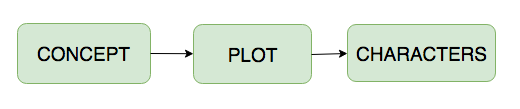
Concept >>> Plot
If you’ve decided that all you really have is a concept, then how do you take it and turn it into a plot? You brainstorm. All brainstorming really amounts to is expanding your ideas. All you’re doing is asking questions about the concept and delving deep into the answers.
The most simplistic way to start this process, especially if you’re struggling, is to ask one of two questions (or both, if applicable). These two questions: What could go wrong? What could go right?
Going back to my example about a world where everyone grows up with superpowers. If I were to ask the question “what could go wrong,” I’d end up with a whole list of possibilities.
The powers suddenly disappear
People start abusing their powers
Someone figures out how to steal powers
A hierarchy of strong vs. weak powers develops, creating superiority/inferiority dynamics
Someone is born without a superpower
There are many more possibilities I didn’t even think of here, but any one (or more) of these could become a plot. Choose one that sounds interesting, and then ask yourself “and then what?”
Say I choose: Someone figures out how to steal powers. Then what does that person do? Do they recruit people to do the dirty work for them? Do they work alone? Do they hoard these powers and barter them for other goods? Do they attempt to enslave people? Do they attempt to take control of institutions? What do they do?
Your goal is to take your ideas and turn them into actions taken by characters. People doing things. And each piece you add will usually lead into another. If you went with the idea that this character is stealing powers and essentially selling them for other goods, you’d have to ask yourself follow-up questions. First, who are they selling to? Why would anyone buy a new superpower if they already have one? What uses would they have for additional ones? What is the key demographic that this person is trying to reach? Secondly, what are they selling them in exchange for? Money? Favors? Souls? What is this character getting in return?
Now that you’ve examined potential actions that the character takes, you’ve also exposed potential new characters.
People they’re stealing from
People they’re bargaining with
People that try to police these crimes
People that try to copy this character’s process
At the beginning of this section, I talked about using “what could go right” as another optional jumping off point. This is a good path to follow if your concept is already really negative. For a concept where someone is killing people for some pointed reason, you might ask “what could go right” and explore ideas where the killer is caught and brought to justice.
The point of all this is to think about change as a means of taking your idea from concept to plot. A concept is static – it doesn’t move, evolve, or change. By developing a plot, you’re forcing the concept to be challenged in some way. If you think about it that way, you’ll be able to formulate conflicts, and the people that orchestrate and fight against those conflicts.
On that note, I think we’re ready to move onto the third piece of my graphic above.
Plot = Character Actions and Consequences
At this point, you have sketches for characters. You’ve got this nameless, faceless person that is stealing the powers, and all these other nameless, faceless people that I listed above. In essence, we have character concepts. And just like we turned our initial concept into a plot, we have to turn these character concepts into actual characters.
The basics are the easiest way to start. You figure out their name, their gender identity, their age, their appearance, some brief backstory and personality traits. I personally prefer the simplest questionnaire that I put together back in the early days because it hits on the poignant pieces of a character without overwhelming you with 100s of questions.
Now that you’ve given your character concepts names and faces and potential behaviors, you start to consider how one character’s view of the world inspires them to take certain actions, and you then think about how those actions affect your entire story.
We already kind of talked about the motives of the power thief in our example, but definitely delve deep here. On the surface, this character seems bad – stealing from people and then selling what they steal. But depending on what it is they’re getting in return, could we not argue that this character is a supernatural Robin Hood? Maybe instead of selling, they’re giving, and maybe the characters they’re stealing powers from are people that abuse and misuse their powers. Character motives can take a plot and turn it on its head, forcing you to reconceptualize everything. And that’s okay! That’s part of the process.
But separate from that idea, if we have a character concept of someone whose powers were stolen, and after developing their basic backstory, we discover that person’s name is Rose, and she has an especially close relationship with her brother. So when her powers are stolen, how does this affect her life? Was she using her powers to keep her brother alive and protected? What she using them to keep a roof over their heads? Was she using them as part of her job, as a means of providing? What happens to her life when her powers are stolen? And what will Rose do about it? Whatever Rose does will impact the story. If she does nothing to get her powers back, how does she solve her problems and does that make for a good story? If she does decide to act, then you’ve moved onto a new plot point to dive deeper into.
My point is, character concepts come from plots, but characters themselves often create plot, as their decisions and mistakes and successes create new outcomes. So if I could modify my original flow chart:
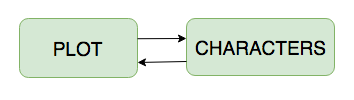
Before you develop something, you conceptualize it. You have a concept, then you make it a plot. You have concepts for characters, then you make them characters. And those characters end up driving your plot, to the point that this happens:
Plot inspires character. Character inspires plot. And it just keeps going around and around and around. Breaking it down into these pieces helps organize the process, but developing a story is rarely this neat and tidy. You’ll get ideas that don’t make sense, ideas that aren’t cohesive, characters you don’t need, characters that piss you off, problems you can’t solve, or plot points you’ve committed to that you no longer like…it will be messy. But it’s your mess, and the more you work on developing your own process, the more it’ll make sense to you. And it’ll become easier to know how to go about fixing it when something’s not right.
Have fun with this process! It’s supposed to be fun. When the pieces start to become clearer, you’re able to put them together in a rough outline. And once you have a rough outline, you can start writing, and really see it take shape.
People sometimes send me Asks wanting writing advice. I suck at it. I don’t really know how I do the writing, or how one should do the writing, or what one should do to get better at the writing. All I can ever think to say is “write a lot of stuff and you will get better at the writing.” Which is true, but hardly a bolt from the sky.
Well, as it turns out, I do have one piece of Legit Writing Advice, and I am going to share it with you, right now. If you were in any of my writing workshop groups at a con, you’ve heard this advice already.
Warning: you’re going to fucking hate it. But if you do it, you will thank me.
If you have a piece of fiction you’re serious about, something you might want to actually shop around, or just something you really are into and want to make it as good as you can…do NOT edit it.
Repeat. DO NOT EDIT.
REWRITE.
As in, print out the whole fucking thing and re-enter it, every word (or use two screens). Retype the whole thing. Recreate it from the ground up using your first draft as a template. Start with a blank page and re-enter every. single. word.
I hear you screaming. OH MY GOD THAT’S INSANE.
Yes. Yes, it is.
It is also the most powerful thing you will ever do for a piece of fiction that you are serious about.
Now, let’s get real. I don’t do this for most things. I don’t do it for my fanfiction. But if it’s something original, something I might like to get to a professional level – I do it. You absolutely COULD do it for fanfiction. It’s just up to you and how much time you want to sink into a piece.
You can edit, sure. But you WILL NOT get down to the level of change that needs to happen in a second draft. You will let things slide. Your eyes will miss things. You will say “eh, good enough.”
The first time I did this, on someone else’s advice, I was dubious. Within two pages, I was saying WHY HAVE I NOT BEEN DOING THIS ALL THE TIME. I was amazed at how much change was happening. By the time I got to the end, I had an entirely different novel than the one I’d started with. When you’re already re-entering every single word, it’s easy to make deep changes. You’ll reformat sentences, you’ll switch phrases around, you’ll massage your word choice. You’ll discover whole paragraphs that don’t need to be there at all because they became redundant. You’ll find dialogue exchanges that need reimagining. Whole plot points will suddenly be different, whole story arcs will reveal their flaws and get re-drawn.
You cannot get down to the fundamental level of change that’s required just by editing an existing document. You have to rebuild it if you really want your story to evolve. You will be AMAZED at the difference it will make.
It will take time. It will seem like a huge, Herculean task. I’m not saying it’s easy. It isn’t. But it is absolutely revolutionary.
Try it. I promise, you will see what I mean.
*PSA: Tipsy!Lori wrote this post. In case you couldn’t tell.
maybe i should try this with my comic scripts.
This advice is real.
I reblogged this earlier on kind of a “that sounds interesting. might work, might not, can’t see it being drastically different but whatever I should try.” kind of note
I’ve got a short story due today at 5, so I decided to do this and completely rewrite the first draft.
OH. MY GOD.
This is legitimate. It’s let me completely gut scenes I was unhappy with, rewrite them entirely differently and not feel any loyalty to what I used to have.
It’s taking a long time. It’s a commitment. But heck so is writing.
This is great. Do this. It’s amazing.
This is such good advice. I’ve done it a few times, and it completely transforms your work. It’s a time consuming process, but it’s absolutely worth the investment. I highly recommend this on things you truly care about. It’s incredible.
I was going to be like “this is ridiculous, what an unreasonable standard” and then go off in a huff to work on an article, and then I remembered that the way I write articles now is by doing an audio draft, and then basically rewriting the article entirely while listening to the audio draft… so… yeah. This is probably actually really good advice. >_>



 willowfoot