So let’s say you’re in the same boat I am (this is a running theme, have you noticed?) and you’ve just got, like, SO MUCH STUFF that HAS to get done YESTERDAY or you will DIE (or fail/get fired/mope). Everything needs to be done yesterday, you’re sick, and for whatever reason you are focusing on the least important stuff first. What to do!
Take a deep breath, because this is a boot camp in prioritization.
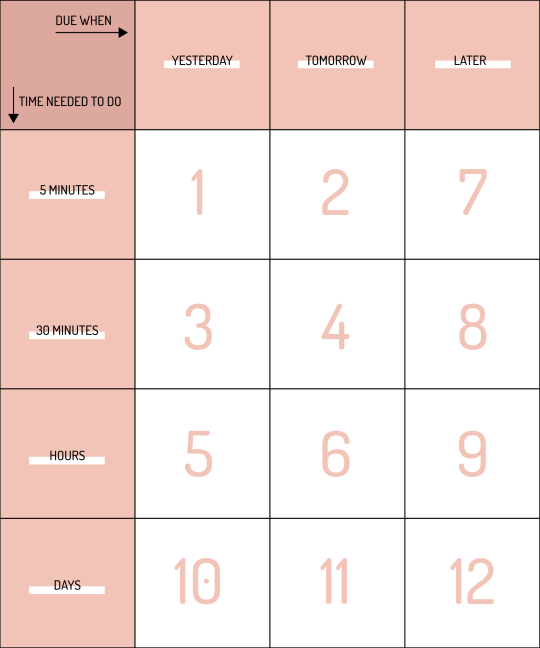
Make a 3 by 4 grid. Make it pretty big. The line above your top row goes like this: Due YESTERDAY – due TOMORROW – due LATER. Along the side, write: Takes 5 min – Takes 30 min – Takes hours – Takes DAYS.
Divide ALL your tasks into one of these squares, based on how much work you still have to do. A thank you note for a present you received two weeks ago? That takes 5 minutes and was due YESTERDAY. Put it in that square. A five page paper that’s due tomorrow? That takes an hour/hours, place it appropriately. Tomorrow’s speech you just need to rehearse? Half an hour, due TOMORROW. Do the same for ALL of your tasks
Your priority goes like this:
5 minutes due YESTERDAY
5 minutes due TOMORROW
Half-hour due YESTERDAY
Half-hour due TOMORROW
Hours due YESTERDAY
Hours due TOMORROW
5 minutes due LATER
Half-hour due LATER
Hours due LATER
DAYS due YESTERDAY
DAYS due TOMORROW
DAYS due LATER
At this point you just go down the list in each section. If something feels especially urgent, for whatever reason – a certain professor is hounding you, you’re especially worried about that speech, whatever – you can bump that up to the top of the entire list. However, going through the list like this is what I find most efficient.
Some people do like to save the 5 minute tasks for kind of a break between longer-running tasks. If that’s what you want to try, go for it! You’re the one studying here.
So that’s how to prioritize. Now, how to actually do shit? That’s where the 20/10 method comes in. It’s simple: do stuff like a stuff-doing FIEND for 20 minutes, then take a ten minute break and do whatever you want. Repeat ad infinitum. It’s how I’ve gotten through my to do list, concussed and everything.
You’ve got this. Get a drink and start – we can do our stuff together!
WOAH THIS SOUNDS HELPFUL. I’M GOING TO TRY THIS IMMEDIATELY. Also, I made a chart for myself, but if anyone else wants it for reference (or if this is wrong and I misread you can tell me) here it is:
Thank you so much, anon! There are tons of guides online for dialogue punctuation (try here or here for full explanations), but here’s a quick refresher:
Bob said, “If your dialogue tag—’Bob said’ in this example—comes at the beginning, it should look like this.”
“If you’re using a dialogue tag at the end, end with a comma, and don’t capitalize your dialogue tag,” Bob said.
“If you split up the quoted sentence around the tag,” Bob said, “it should be punctuated like this.”
“Unless your quote is two separate sentences,” Bob said. “In that case, there is a period after the tag.”
“You can also leave out the dialogue tag completely, if you know for sure who’s talking.”
“What about question marks?” Bob said. “Shouldn’t we capitalize the tag after a question mark or exclamation point?”
“Nope!” said Bob. “You don’t need to unless the tag is naturally capitalized (as with I or a proper noun like a name like Bob).”
“Is it Bob said or said Bob?” asked Bob.
“It can be either,” Bob said, “but we don’t use ‘said she’ or ‘said I’ often anymore, so it is best to avoid those constructions with pronouns and use ‘I said’ and ‘they said’ unless you wish to sound archaic.”
Bob took a sip of coffee. “You can even include action, but as it is not a dialogue tag, put a period at the end of the action.”
“Really?” Bob leaned closer. “There are so many rules.”
I think that should cover most situations you might come across, but if you have anything specific I’m happy to help. Remember, you can always grab any fiction book off your shelves and find an example that’s a similar construction to what you’re writing. Or, just rewrite it to a construction you’re familiar with.
I see a lot of writing advice, particularly about giving characters flaws. The main advice is “everyone has flaws! make sure to give your character flaws or else it’s not realistic!” And after thinking about it… I would like to challenge this.
It essentially posits a view of human nature that there are good and bad traits, and that these traits can be neatly diagrammed into separate columns, one set of which can and should be eliminated. It tends to go along with a view that posits character development should be about scrubbing away of “flawed” traits until the character achieves more a higher level of goodness, or else the character doesn’t and falls into tragedy. This is not untrue, necessarily. There are definitely some “flaws” that are 100% bad and sometimes a good arc is about slowly losing them. However, I could call this advice incomplete.
Consider thinking about it this way. Characters have traits and often whether or not that trait is a flaw is purely circumstantial.
For instance, fairy tales I read as a child. In some, when an old beggar asked for money on the road, it was a secret test of character. The prince who gave the old man money or food would be rewarded. But in other folktales I read, the old beggar would be malevolent, and any prince who stooped to help him would be beaten, punished for letting his guard down. Now, in a story as well as in real life, either of these scenarios can occur–a stranger who asks for help can be benevolent or malevolent. So which is the flaw? Is it a “flaw” to be compassionate? or is it a “flaw” to be guarded?
Trick question–it’s purely conditional. Both traits are simultaneously a strength and a weakness. Either has an advantage, but either comes with a price as well. And whether the price is greater than the advantage depends on circumstance. The same can be said for most character traits, in fact!
An agreeable character who gets along with everyone will be pressured into agreeing with something atrocious because it’s a commonly held viewpoint. A character who’s principled and holds firm even under great pressure will take much, much longer to change their mind when they are actually in the wrong. A character who loves animals and loves to shower them with affection will get bitten if they try the same on every animal. As the circumstances change, flaws become strengths, and strengths become weaknesses. And even a trait that’s wholly virtuous, such as compassion, comes with a price and can be turned for the worst.
You don’t have to think about inserting flaws into your character. Your character, even the most perfect “Mary Sue,” is already flawed the moment you give her any traits at all. The problem with Mary Sue isn’t a lack of flaws, it’s a lack of circumstances to challenge her properly, to show her paying the natural price. Your job as an author is to create circumstances in the narrative that 1) justify why these traits exist in your character 2) show what your character gains from these traits and then 3) change the circumstances to challenge her.
Make your character pay the price for their traits, for their choices. And then, when challenged, you can make a hell of a story by showing us how they adapt, or why they stick to their guns anyway.
ok so I don’t usu reblog this stuff here but last year I had a horrible experience with an Airbnb host who threatened to bust my kneecaps, stalk me and murder me right? And not only did I GO TO THE POLICE before cancelling the reservation, but I also provided copies of that documentation to Airbnb customer service (I should mention after hunting down that number in the depths of the stupid internet and being on hold for an hour). Did they give me a refund for the months I’d paid in advance? No – they accused me of lying!
A few weeks later in a fit of desperation, a coworker suggested I tweet to Airbnb. Ok. I have maybe 30 followers on Twitter, and didn’t really use it at the time, but I thought, fuck it. Nothing to lose now. I made a half assed attempt at an overly indignant tweet with plenty of capitalization, and you know what happened?
Within the HOUR. It was taken down. I was DMed by a CSR. And I was given a FULL. REFUND.
$1500 like THAT.
I don’t know what kind of dystopic fucking reality we live in where police reports mean nothing and the PR value from a half assed tweet to 30 followers outweighs the safety of my kneecaps, but. Social media… Lesson learned, I guess.
After putting my writing on hold for several weeks, I decided to jump back in. I expected to find all sorts of problems with my story–inconsistencies in the plot, lack of transitions, poor characterization–the works. But what began to stick out to me was something to which I’d given little thought in writing.
Filter words.
What are Filter Words?
Actually, I didn’t even know these insidious creatures had a name until I started combing the internet for info.
Filter words are those that unnecessarily filter the reader’s experience through a character’s point of view. Dark Angel’s Blog says:
“Filtering” is when you place a character between the detail you want to present and the reader. The term was started by Janet Burroway in her book On Writing.
In terms of example, you should watch out for:
To see
To hear
To think
To touch
To wonder
To realize
To watch
To look
To seem
To feel (or feel like)
Can
To decide
To sound (or sound like)
To know
I’m being honest when I say my manuscript is filled with these words, and the majority of them need to be edited out.
What do Filter Words Look Like?
Let’s imagine a character in your novel is walking down a street during peak hour.
You might, for example, write:
Sarah felt a sinking feeling as she realized she’d forgotten her purse back at the cafe across the street. She saw cars filing past, their bumpers end-to-end. She heard the impatient honk of horns and wondered how she could quickly cross the busy road before someone took off with her bag. But the traffic seemed impenetrable, and she decided to run to the intersection at the end of the block.
Eliminating the bolded words removes the filters that distances us, the readers, from this character’s experience:
Sarah’s stomach sank. Her purse—she’d forgotten it back at the cafe across the street. Cars filed past, their bumpers end-to-end. Horns honked impatiently. Could she make it across the road before someone took off with her bag? She ran past the impenetrable stream of traffic, toward the intersection at the end of the block.
Are Filter Words Ever Acceptable?
Of course, there are usually exceptions to every rule.
Just because filter words tend to be weak doesn’t mean they never have a place in our writing. Sometimes they are helpful and even necessary.
Susan Dennard of Let The Words Flow writes that we should use filter words when they are critical to the meaning of the sentence.
If there’s no better way to phrase something than to use a filter word, then it’s probably okay to do so.
Want to know more?
Read these other helpful articles on filter words and more great writing tips:
100% correct medical information on tumblr for once; also consider calling 911 if you don’t know how often the person has seizures and ESPECIALLY if the seizure has lasted 5 minutes or more (which is why the watch is critical)
I have epilepsy so making sure the word is out on how to help people who do have seizures means a lot to me.
Same here. I know its more scary for anyone watching than for the person who who has epilepsy (until later on).

 willowfoot