1. Read media by people in the group. Fiction, nonfiction, blog posts – anything from “how my day went today” to 300-page epic adventure novels to history pamphlets. (By people in the group, not just about them. This is important.)
2. Google “How not to write a [the group] character” because the odds are that at least a few people in the group have written blog entries rattling off all their least favorite tropes representing their demographic. I’ve seen lesbians writing about how not to write lesbians, Asians talking about offensively-written Asians, etc. Refraining from writing the overused, negative, one-dimensional tropes listed in posts like this is probably a good start.
OutWeek Magazine was the seminal lesbian and gay publication during the peak era of AIDS activism in the late 80s and early 90s.
Founded by Gabriel Rotello and Kendall Morrison, it employed a staff of about 30 people in Manhattan during its tumultuous two-year existence.
OutWeek redefined the role of the activist gay press, not only by reporting the news but also by frequently making news itself. Its aggressive coverage, incisive commentary and in-depth investigative articles on gay rights, politics, AIDS, the arts and popular culture made it a must-read publication far beyond the usual scope of gay magazines.
Several of the most contentious controversies of that era were sparked by OutWeek. The magazine pioneered the use of the word ‘queer,’ which was highly controversial at the time. It was closely associated with the AIDS activist group ACT UP, and several of its staffers and contributors helped to co-found the group Queer Nation.
Many of OutWeek’s editors were committed to sharply challenging the then-pervasive culture of the closet, and a sideline of that commitment – the advocacy of ‘outing’ prominent gay and lesbian celebrities – began in Michelangelo Signorile’s “Gossip Watch” column and was one of many things that made OutWeek a household name and a lightning rod.
OutWeek was committed to an inclusive vision of queer life, and was the first major national publication to bill itself as a ‘lesbian and gay’ magazine.
this is a really exciting resource! especially if you’ve ever wished you could get a better view into gay/queer/lgbt activist culture in the early ’90s, you gotta check this out
fucked up how cooking and baking from scratch is viewed as a luxury…..like baking a loaf of bread or whatever is seen as something that only people with money/time can do. I’m not sure why capitalism decided to sell us the idea that we can’t make our own damn food bc it’s a special expensive thing that’s exclusive to wealthy retirees but it’s stupid as hell and it makes me angry
bread takes like max 4 ingredients counting water and sure it takes a couple hours but 80% of that is just waiting around while it does the thing and you can do other things while it’s rising/baking
plus im not gonna say baking cured my depression bc it didn’t but man is it hard to feel down when you’re eating slices of fresh bread you just made yourself. feels like everything’s gonna be a little more ok than you thought. it’s good.
bread is amazing and it’s also been sold to us as something really hard to make? Every time I tell someone I made a loaf of bread I get reactions like “you made it yourself???” and “do you have a bread machine then?” I haven’t touched a bread machine in probably 10 years. You CAN make your own bread, folks, and it’s actually pretty cheap to do so. I believe the most expensive thing I needed for it was the jar of yeast. It was about $6 at the grocery store and lasted me MONTHS (just keep it in the fridge.) The packets are even cheaper. destroy capitalism. bake your own bread.
You can also make your own yeast by making a sourdough starter, so that cuts cost even more.
But you have to feed the starter daily/weekly and that means it grows quickly, but there are tons of recipes online for what to do with your excess starter. Cookies, pretzels, crackers, pancakes, waffles, you name it!!
Make it even easier – “No-Knead Bread”. All YOU do is mix the ingredients together and wait until it’s time to heat the oven. The yeast does all the rest.
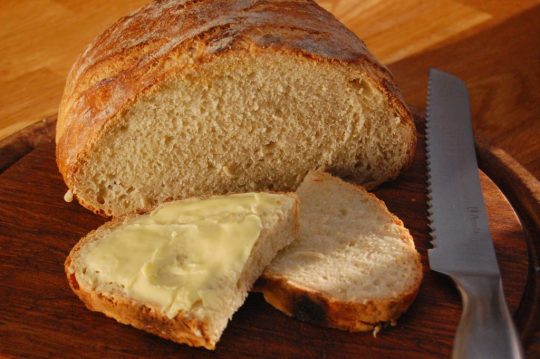
Here’s @dduane’s first take on itand the finished product. We’ve made even more photogenic batches since.
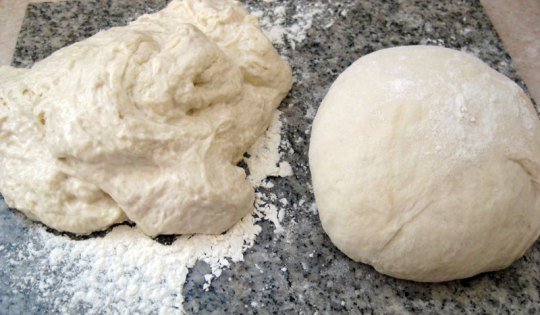
Kneading is easy as well; either let your machine do it, or if you don’t want to or don’t have one, get hands-on. It’s like mixing two colours of Plasticine to make a third. Flatten, stretch, fold, half-turn, repeat – it takes about 10 minutes – until the gloopy conglomeration of flour, yeast, salt and water that clings to your hands at the beginning, becomes a compact ball that doesn’t stick to things and feels silky-smooth.
Here’s what before and after look like.
My Mum used to say that if you were feeling out of sorts with someone, it was good to
make bread because you could transfer your annoyance into kneading the
dough REALLY WELL, and both you and the bread would be better for it.
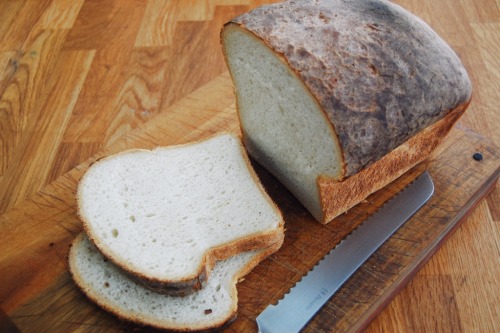
Then you put it into a bowl, cover it with cling-film and let it rise until it doubles in size, turn it out and “knock it back” (more kneading, until it’s getting back to the size it started, this means there won’t be huge “is something living in here?” holes in the bread), put it into your loaf-tin or whatever – we’ve used a regular oblong tin, a rectangular Pullman tin with a lid, a small glass casserole, an earthenware chicken roaster…
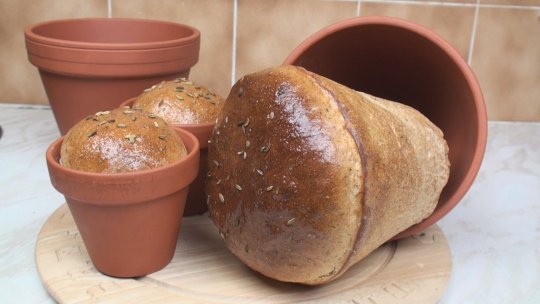
You can even use a clean terracotta flowerpot.
Let the dough rise again until it’s high enough to look like an unbaked but otherwise real loaf, then pop it in the preheated oven. On average we give ours 180°C / 355°F for 45-50 minutes. YM (and oven) MV.
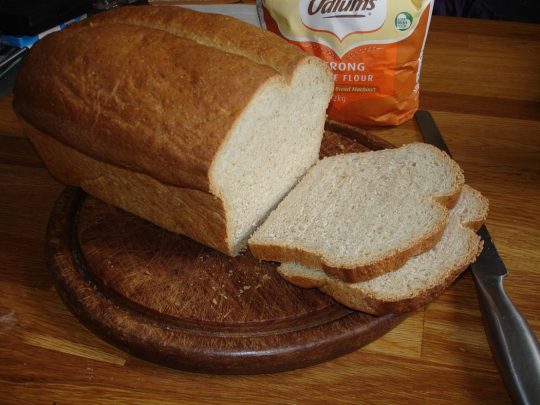
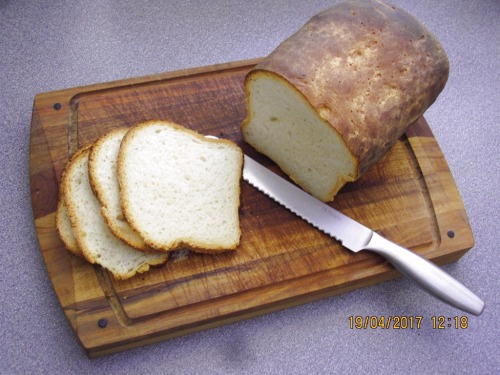
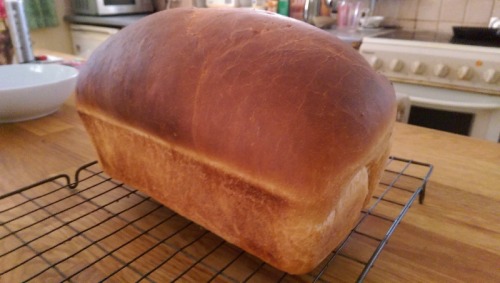
Here’s some of our bread…
Here’s our default bread recipe – it takes about 3-4 hours from flour jar to cutting board depending on climate (warmer is faster) most of which is rise time and baking; hands-on mixing, kneading and knocking-back is about 20 minutes, tops, and less if using a mixer.
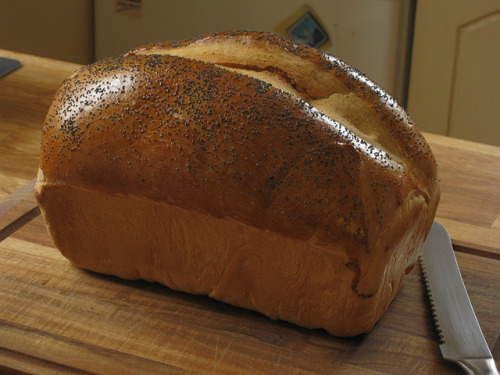
Here ( or indeed any of the other pics) is the finished product. This one was given an egg-wash to make it look glossy and keep the poppy-seeds in place; mostly we don’t bother with that or the slash down the middle, but all the extras were intentional as a “ready for my close-up” glamour shot.
I think any shop would be happy to have something this good-looking on their shelf.
We’re happy to have it on our table.
Even if your first attempts don’t work out quite as well as you hope, you can always make something like this…
can we have more posts like this in future please? this is really useful and could help those who are struggling
You got a clean jar and some full fat cream?
Make your own butter as well and really have a good time.
i didn’t see around a lot of indications about this, so i decide of making some short, direct and usefull indication based even on my experience. (feel free to add tips)
Why create a religion for my world?:
Religion is a big part of every culture that can influence the daylife of larg group of people so it’s important to define it if present in your world. The other thing is that is a good way for worldbuild, you can define the life of people, the way cities are built and the way of think of the population.
Where to start:
– Polytheist or monotheist: choose the type of religion that fit better your world, it’s important because polytheist and monotheist religions have some differencesthat have relevance when you write. (not only the number of gods but for example how gods are workship or how are build temples)
-Read about real religions: this is a good base and you are going to see a lot of aspect that you have to take count of. Reinterpret is a way of creating a new one, so you can take prinples for example.
–Decide the characteristics of the God/s: After have a clear idea of what you want to do (example: religion similar to Romans’ one or a mix between Egyptians and Greeks gods) you have to put cleare some poits:
Is you god/s good or bad? : so how is see by humans, what is famous for, which is their temper, is revengeful or their forgive, if it is feared or loved or both. If you create more gods then you can decide to make them represent somenthing.
Did your god/s in contact with humans?: The relationship with humans; so if they are between humans and if humans know about it. In this case when and how they do so. If they don’t meet humans you have to decide if they communicate with them and how.
Physical appearance: if they had a physical appearance describe it or describe characteristics that the god have when in physical form.
– Worship: While the poits before where about the poit of wiew of the God/s, you have always to define how humans venerate God/s. Some points:
Is all the population religious?: This is important because there you can determine the relationship between who belive and who not or between different religions. Or say if is imposed.
What role have religion in the State: So if religion have a political power, how much power have and if is used for good or for bad.
What are the religion institutions: There is a leader of the cult, what are the offices and how they are built, how much the istitutions influence the population.
Where: where is workshiop God/s (temples or churches or at home)
HOW: this is probably the most important aspect but the more compless too. Here you need to define how people practice their own religion so if they only pray or do make sacrifices, if there are rules that influence the daily life, if there are festivity or particular ritual, if there are simbols that are workship.
The Name: The name can be 1 word or more but it’s better if not more than 4 because it have to be somenthing that affect. It can be a word or a period that describe a foundamental principe of your new religion, or somenting like “The believe of X” .
A thing that is always good to keep in mind is that religions tend to give a sense of belonging to the believers. This can be use in a lot of way and is a important specially if your new religion have political power or a big influence on population.
I know there are a quite a few posts on tumblr already about studying mathematics but I figured I’d jumped in with some less conventional things that have worked..
1- believe you can. This may be an overused phrase but it’s that way for a reason. So many people have this negative way of thinking that math is hard and when they walk into a classroom they’ve already concluded that it is going to be difficult for them and that they’re going to fail. I’ve personally done this and I have to remind myself that I can do it and not to be resolved to failure. It helps, drastically.
2- If you have trouble remembering formulas I have a system that I use, it’s pretty simple, all you need is a notebook( I prefer a very mini one to make carrying it easy). On the first few pages I have some of the basics such as Types of Numbers, order of operation, perfect squares and such and then i use a double page spread where the left side has what I’m finding and the right side has the formula. Sometimes there isn’t a specific formula so I list the steps or an example.
3- Another method to help with remembering formulas is to always write it. Whenever you’re doing a new topic and your teacher gives you an exercise to do write the formula before each question, even if that means you have the formula written ten times on one page.
4- PRACTICE!PRACTICE!PRACTICE! This is the best way to improve in maths. Do one sum ten times, do test papers, do exercises from your textbook even if you teacher doesn’t assign them.
5-And on the topic of practicing, practice topics even after you’ve moved on in class. It’s the worst thing to be studying for an exam that covers various topics and you realize you only remember the more recent work and forgot the work you did at the beginning of the term. This is my biggest problem and I’m desperately trying to combat it and the best way may be setting side about an hour a week and doing sums, it doesn’t even have to be a lot, just 3 or 4 sums from each topic.
6- Don’t move on from a topic if you don’t understand it. This is the worst thing you can do. It’s likely your teacher will ask the class if everyone understand and you should raise your hands, don’t be afraid or embarrass, one: because it’s their job and two: because chances are some of your classmates don’t understand or know what it feels like not to understand. It’s also important to remember that different people have different way of explaining things so try seeking out other teachers and asking for help or other students or even trying the web,
7- Statements. These are so damn important. Ever reviewing over your notes and you can’t understand how you got from one point to the other? That’s what statements are for. Honestly as someone who relies on statements to figure out how to work out a math sum when I don’t understand or miss class it’s very helpful. Also I’m not sure about elsewhere but here the correct answer is typically only 1-2 marks and statements and workings carry the rest.
8- LEARN HOW TO USE YOUR CALCULATOR!
For exams:
1-keep a sheet of paper that has all major topics and their respective sub topics and I use it to keep track of whether you’ve reviewed the topic for test another thing you can do is rate your understanding of the topic: 1 star/circle/heart= poor understanding to 5 stars/circles/hearts=excellent understanding. Be truthful with yourself.
2-Go over and DO OVER questions you did through the term and if your teacher does a review session at the end of the term then definitely go over those, it’s likely these questions will be on your test paper but with different values.
3-Sometimes questions can be worded in a way that is tricky, read it carefully and underline the important parts and what they’re asking you to find.
4- One of the ways I check to see if my answer is correct is working back the sum so for example 2 x 5= 10 then 10/5=2.
5- don’t freak out or psych yourself up, you’ll do great and if you don’t then learn from your mistakes!
I hope this little post helped someone. Remember that math will only be as frightening and hard as you imagine it to be,
google search any topic followed by ‘filetype:ppt’ and only powerpoints will come up, or a textbook or subject name followed by ‘filetype:pdf’ to find free textbooks in pdf form
I feel like the reason certain dog-lovers insist cats are evil is because they read their body language as if they were dogs. So here’s a very basic guide to common “mean” things cats do that actually aren’t mean at all if you know what they’re thinking.
Rolling and exposing belly- attacks you when touched Does not mean: Give belly rubs! – haha I tricked you! Actually means: I’m playful! If you reach for my belly I’ll grab your arm and bite it because I think we’re playfighting!
Lazily exposing belly – still attacks when touched Does not mean: tricked you again! Actually means: I’m showing you my belly because I trust you. Please don’t break that trust by invading my personal space. I might accept a belly rub if I’m not ticklish and I know you well.
Snapping at you while being pet Does not mean: I suddenly decided I dislike you! Actually means: You’re petting me in a way that gives me too much restless energy. Please focus on petting my head and shoulders instead of stroking the full length of my back next time.
Is in the same room but makes no attempt to interact Does not mean: I’m ignoring you Actually means: We’re hanging out! I’m being respectful by giving you space while still enjoying your company.
Slapping/scratching your hand when you try to pet them Does not mean: I hate you! Actually means: You’ve failed to establish that we’re not playing, or the way you’re approaching me scares me. Be calmer, speak more gently, make eye-contact and blink slowly at me before you try again.
I love this post omg, thank you so much. As a lifelong cat person, dogs perplex me because they’re so completely different behaviourally.
I love dogs too but, I’ve been trying to tell people, you canNOT treat cats like you treat dogs. They arent the same animals and have very different personalities
P.s.: people often pet cats way too hard. Dogs like a firm pet or a pat on the belly, cats dont have the same bone structure and are more flexible than dogs so what you’re doing probably hurts them
Sitting and staring Does not mean: I am challenging you/plotting your demise/just generally evil and creepy. Actually means: I am a desert-adapted species, so my natural tears are very thick and keep my eyes moist for a nice long time. I do find people interesting and enjoy watching them. I just don’t need to blink very often!
Staring and blinking slowly Does not mean: I’m smug and think I am smarter than you. Actually means: I like you! But I don’t need to get up in your face to show it. I can just sit over here and blow kisses at you to show you I am glad you are around!
It’s very frustrating for me when people expect cats to act like dogs, or act like they’re deceitful. They aren’t! They just AREN’T DOGS.
– protect your extremities aka toes and fingers and head
– don’t let wind inside so block every inch of skin except the eyes and even there if you can get away with a ski mask, do it.
– don’t care about how you look, everyone’s staring at the floor because that’s how you stop cold air from entering in the coat’s neck hole
Never underestimate what a huge difference an extra layer, even a thin layer, can make. I thought my mom was bullshitting me all those Midwest winters when she told me that wearing a tank top under my shirt helps beat the cold. That shit is MAGIC.
And I tried the leggings trick last winter, just leggings under my trousers, and that is…I was locked out of a building in like 20 degree weather last winter and I just stood there like meditating until someone let me in because I was so toasty warm that I wasn’t even that mad. (THAT mad.)
This is a very good example of a warm coat–any puffer jacket will be your BEST BEST friend. If you live somewhere as cold as or colder than Minnesota it needs to be a long jacket that covers your butt, according to my sister who lives in Minnesota. Other very warm jackets include good pea coats and…okay, honestly, pea coats and puffer jackets are the only two coats I trust to get me through my Iowa winters. (If you get a pea coat, it’s essential to have a hat that covers a lot of your head, like the one Shitty Knight often wears.)
Yeah. Good shit. I get really passionate about winter clothes. Thanks for making this.
A decent option if your jacket doesn’t cover your butt is a wide scarf/skinny shawl – just wrap it around your hips like a kilt, and it’ll keep your buns and thighs a little less frozen while waiting for the bus.
I find I only need the thigh/butt cover if the windchill’s below -25C – above that, even with wind, leggings under my jeans are enough to keep me pleasantly warm, but ymmv, i grew up with prairie winters.
Another good tip – try not to have the layer closest to your body made out of cotton, or bring a change of base layer (including socks). Even when it’s freezing out, if you’re doing any moving around you’ll sweat – cotton holds onto the sweat but not the heat, and so you’ll end up chilled all day, which sucks. Good base layers include thermal underwear (best is wool or silk, but silk is expensive and wool can be an allergy problem. really there’s nothing wrong with synthetics as long as you’re not getting close to open flame) and exercise/ running gear.



 willowfoot