Something I think a lot of fantasy roleplaying fans don’t pick up on is that the reason many games’ depictions of orcs and other “monstrous races” get criticised for being racist isn’t just because they’re dark-skinned and evil.
I mean, yes, there’s that, but it’s also that a lot of the tropes that are associated with orcs and such in fantasy RPGs are literally eugenicist rhetoric – and, more specifically, anti-Black eugenicist rhetoric – with the serial numbers lightly sanded off.
Like, you ever notice how common the following elements are?
Being capable of using complex tool and weapons, but relying on raiding and pillaging to obtain them, not because they’re incapable of making them, but because they’re simply too
congenitally
lazy to do so
Having an intrinsic drive to despoil and corrupt the fruits of civilisation, and in particular, taking pleasure in destroying beautiful things specifically because they’re beautiful
Being treated as childishly superstitious for believing in evil spirits, even though such treatment makes no sense from a worldbuilding perspective because they live in a fantasy setting and evil ghosts are objectively real
Reproducing rapidly and reaching sexual maturity quickly, typically at an age when a human would still be a child, with great emphasis placed on the danger of them “outbreeding” civilised peoples if left unchecked
Lusting for the women of other species, resulting in all manner of twisted half-breeds; “heroic” members of their kind are typically drawn from these half-breeds, who must struggle constantly with their base natures
Seriously, a lot of this stuff is copied and pasted directly from 19th Century eugenicist screeds about the intrinsic inferiority of the Black race – they basically just scratched out the n-word and wrote in “orc”.
(And no, you can’t pass it off as folks imitating Tolkien without realising what they were doing. While Tolkien’s orcs undeniably employ racist imagery and stereotypes, there it’s mostly anti-East Asian stuff, not anti-Black stuff. The incorporation of explicitly anti-Black tropes into fantasy fiction’s depiction of orcs is a more recent development, and at least some of the folks doing it absolutely knew what they were up to.)
I really think Jackson is to blame for the recent anti-black bs with orcs, considering how he codes them.
And while Tolkien’s racism regarding orcs is specifically East-Asian directed, I do think there are elements of anti-blackness regarding his orcs as well. While he never came out and said it, there are certainly things I’ve seen and written about that can’t be unseen.
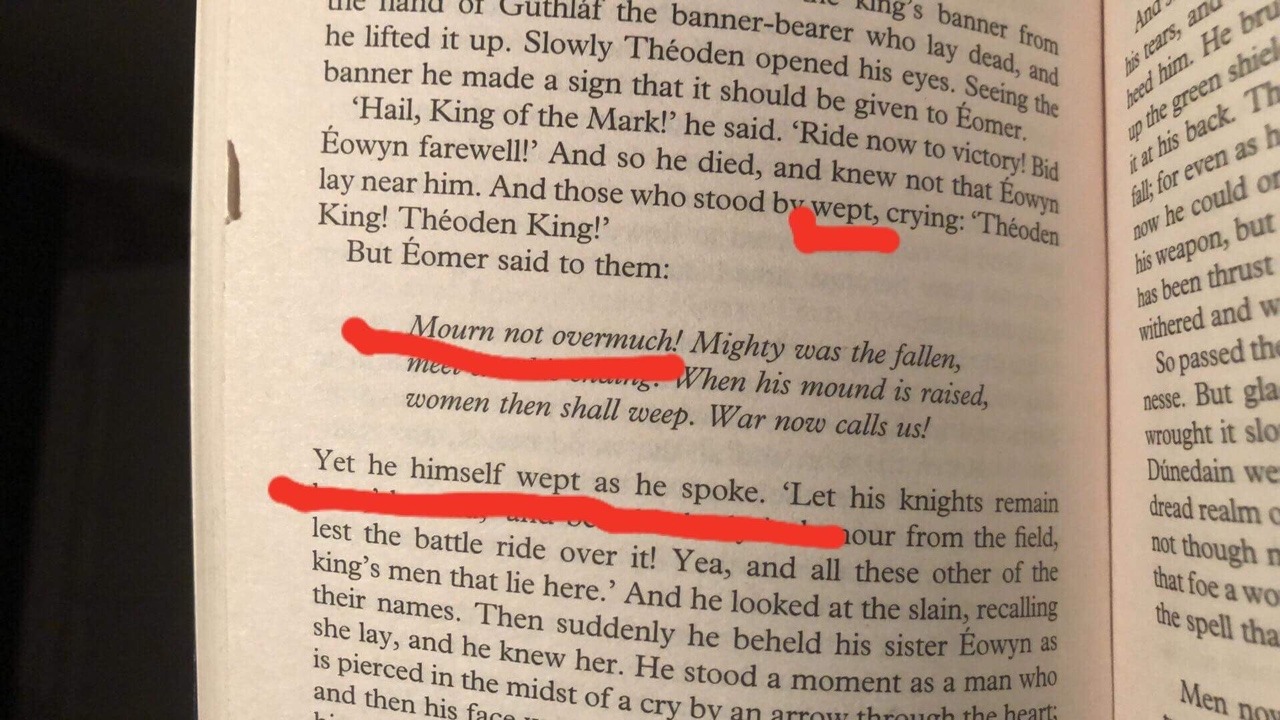
i love how much everyone cries in lotr like aragorn just had his boromir weep and we cut to frodo and he’s sobbing under the weight of his now entirely solitary task like yeah as an audience i need that cathartic placeholder!! well done i’m empathizing and processing my pain!! with big blockbusters today most of the time i come out of the cinema constipated and wondering if the men in them are even supposed to have human feelings
they better fucking weep tho that shit is canonical! you can’t read a page of lotr without a man crying! i was reading rotk a month ago and pointing out this exact thing, just look at all these men with actual emotions!
Éomer, to an army of crying men: Do not cry! We have work to do!
Also Éomer: cries as he says this
I’m not crying, you’re crying
– Éomer, probably
Kind of unrelated so feel free to delete, but I realized seeing this that I actually associate it with the epics we’ve read this term in one of my classes (Gilgamesh, the Odyssey, etc)…like the thing of male characters not being allowed to have emotions in general has gotta be fairly recent (the DRAMA in a lot of 19thc novels man!) but with Tolkien I wonder if it isn’t a callback, not to those specific epics, but to others like them more relevant to times/places he studied?
But anyways yes, I support emotional leeway for men, and be it known that bizarre stoicism doesn’t seem to have always and inevitably been the rule, so
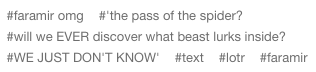
one of my favorite lotr facts is that gondorians speak sindarin as a first language and yet when faramir was talking to frodo and sam about cirith ungol he was like “we don’t know what’s in there.” like faramir. cirith ungol is sindarin for “pass of the spider.” do the math
some of my favorite tags on this post
Don’t forget that Frodo also speaks Sindarin, which makes this even worse.
Faramir: Hey, don’t go up the Spider Stairs.
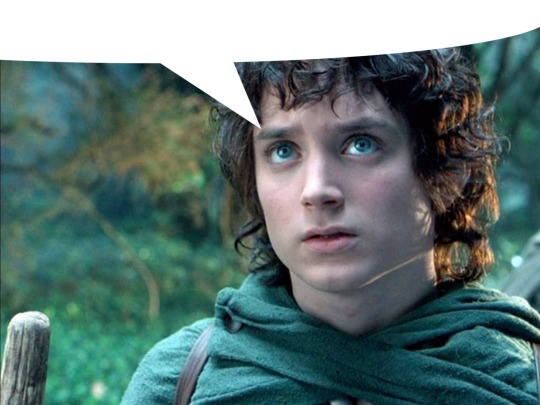
Frodo: Why? What’s up the Spider Stairs?
Faramir: We don’t know, Frodo. We just don’t know.
oh god u know me so well. i read lord of the rings as this beautiful haunting quintessential war poetry – world war one was so unprecedentedly devastating and yet it was supposed to be…the end of war. the war to end all wars. that which made us realize that we had gone too far, and i think that that’s the kind of sentiment that’s brought forth in lord of the rings – frodo’s quest just seems so futile and yet it has to be done because the likely event that it fails is just unthinkable. tolkien lost all his friends in the war – everything in lord of the rings is so lonely, solitary, isolated and isolating. frodo can’t share his burden no matter how much sam begs him to, he withdraws in on himself. aragorn’s destiny and struggle is private and entirely singular. eowyn is adrift. faramir is cut off. and yet – the quest succeeds, they find each other. eowyn and faramir are not alone. sam carries frodo up mount doom. legolas takes gimli to the undying lands. they are all saved by love and connection and i think that this is a cry out for resolution, for renewal, for flowers blossoming across battlefields. the narrative is so balanced between brutalizing isolation and luminary hope
the scene in return of the king where gandalf gets pippin to light gondor’s beacons is a lot funnier when you remember that pippin has already sworn fealty to denethor, which means that he’s a legal citizen of the city and servant of its ruler and therefore committing high treason











 willowfoot