PHOTOS: Transgender Elders Show Us The Meaning of Survival
In the many years that Jess T. Dugan, a Boston-based trans photographer, has spent capturing images of gender-variant people, she says she’s consistently noticed a striking absence in both art and social sciences: imagery of older trans folks.
“And,” Dugan explains further on her website, “those [representations] that do exist are often one-dimensional.” So Dugan set out to fill this gap, teaming up with social work researcher Vanessa Fabbre since fall 2013 to develop the evocative photo project, “To Survive on This Shore.” In the recently released collection, diverse trans elders ages 50 to 86 are pictured at home or in meaningful spaces, gazing unapologetically into the camera, as if asking the viewer to look deeper into their unique context and life story.
OutWeek Magazine was the seminal lesbian and gay publication during the peak era of AIDS activism in the late 80s and early 90s.
Founded by Gabriel Rotello and Kendall Morrison, it employed a staff of about 30 people in Manhattan during its tumultuous two-year existence.
OutWeek redefined the role of the activist gay press, not only by reporting the news but also by frequently making news itself. Its aggressive coverage, incisive commentary and in-depth investigative articles on gay rights, politics, AIDS, the arts and popular culture made it a must-read publication far beyond the usual scope of gay magazines.
Several of the most contentious controversies of that era were sparked by OutWeek. The magazine pioneered the use of the word ‘queer,’ which was highly controversial at the time. It was closely associated with the AIDS activist group ACT UP, and several of its staffers and contributors helped to co-found the group Queer Nation.
Many of OutWeek’s editors were committed to sharply challenging the then-pervasive culture of the closet, and a sideline of that commitment – the advocacy of ‘outing’ prominent gay and lesbian celebrities – began in Michelangelo Signorile’s “Gossip Watch” column and was one of many things that made OutWeek a household name and a lightning rod.
OutWeek was committed to an inclusive vision of queer life, and was the first major national publication to bill itself as a ‘lesbian and gay’ magazine.
this is a really exciting resource! especially if you’ve ever wished you could get a better view into gay/queer/lgbt activist culture in the early ’90s, you gotta check this out
Meaning of the letter “A” when appearing in LGBT[…]+ acronyms:
Asexual: 95.4% of respondents, 1936 total
Aromantic: 80.7% of respondents, 1639 total
Agender: 66.7% of respondents, 1353 total
Ally: 13.9% of respondents, 282 total.
I’m just posting this here for my aces and aros who are feeling down on themselves and defeated tonight. Remember that nine out of ten people support you and that the current loudest voices are not those of the majority.
A few years ago, I came out to my mom the morning after my senior prom. She was surprised, then quiet, then asked what my real orientation was. I said, “I have no idea, but I like this one girl.” She was a little confused, but she kissed me and said, “As long as she makes you happy.” For the next few weeks, she asked a lot of questions: when did I realize? What was my new girlfriend’s orientation? What was the word for this or that? I WAS happy, right?
Fast forward about two years. My mom sits me down and tells me that she needs my help with her next book. She’s been writing middle-grade girls’ books (like, 9-14 range) since I was eight, and she says she has an idea that she really, really wants to get right. It follows the plot of Romeo and Juliet, she says, and the main character is a twelve-year-old girl realizing she has a crush on another girl when they put on the play for English class.
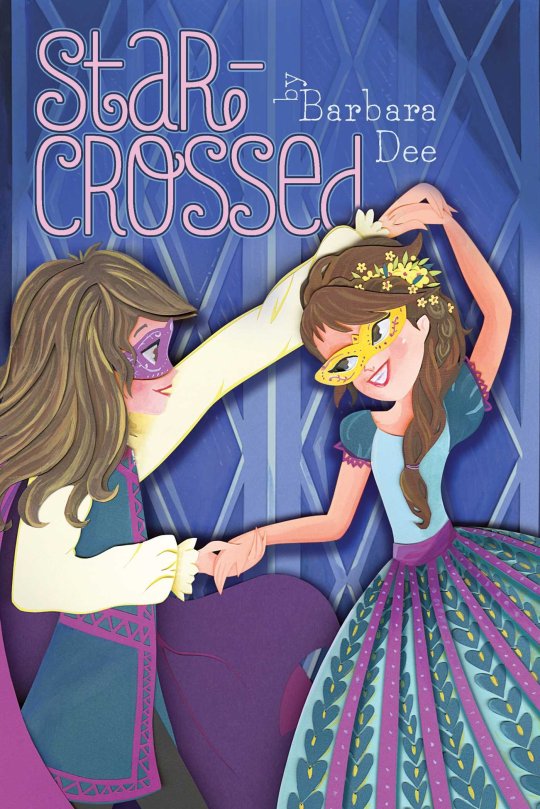
Fast forward another year to now. STAR-CROSSED is about to come out, and it is absolutely amazing.
My mom has poured her heart and soul into making sure this is a positive thing for kids to read.
I’ve been reading and editing and helping with this book since its first draft and I’ve been, metaphorically and sometimes literally bouncing up and down on my heels, waiting to be able to tell people about it. It’s beyond sweet, and there’s a ton of Shakespeare and humor and goofy preteen drama and twelve-year-old girls flirting and Star Wars jokes and a glossary of Shakespearean insults in the back (yes, really), and it’s just so fun and positive and smart and I want to show it to every kid I know.
This book is for LGBT kids, written by a mom who has asked questions and done her research and tried as hard as she possibly could to make her own queer kid feel safe and loved and valid, and it REALLY shows. Mattie (the cutie on the left) and Gemma (the cutie on the right) are given space to learn about themselves, and ultimately they don’t have to figure themselves out right away or come out to everyone at once or choose a label. They’re kids. It’s okay to still be figuring things out. It’s okay.
Fun facts:
My mom said from the beginning she wanted both girls on the cover to make it clear what the book was about; then when they got the final artwork and Mattie’s hair was short, my mom wrote back and asked the artist to do the hair over to make it as obvious as possible that Mattie is a girl.
When a few people started buzzing about Mattie being the youngest bisexual protagonist they’ve seen, she went back and changed passages to confirm that Mattie likes boys and girls.
When I asked for a happier and less ambiguous ending scene, she set Mattie and Gemma up on a frigging date.
It comes out on March 14, 2017. Please join me in GETTING HYPE FOR STAR-CROSSED ❤
EDIT: THE RESPONSE TO THIS POST HAS BEEN SO INCREDIBLE YOU GUY OH MY GOSH. The book has shot to #5 on Amazon’s Hot New Releases list because of you lovelies. If you want to preorder Star-Crossed you can do so here, and if you want to learn more or read reviews or send my mom a nice message you can do so from her site or Twitter. The more reviews it gets on Amazon and Goodreads – even single-sentence ones – the more it gets promoted. I LOVE YOU ALL
what im saying is that bisexuals, pansexual, and asexuals should all join together so we can be in the fictitious trifecta. enough people will say we’re not real and we’ll all converge together in a massive, fierce mass only spoken of in myth. dont come near us or you too will cease to exist
can we include aromantics?
triforce of fabulousness
There we go, a shield to protect against the negativity
Yes please, I would join the force. I brandish my shield against the negativity of the world.
Hello, are you me? Seriously, I have been where you are. I’ll write you back later today when I have the time to answer this properly. ❤
All right, so, leaving out a few bits involving people I love who didn’t plan to have their lives written out online…
In elementary, in first grade, a boy was my best friend. I wrote in my diary that I loved him. He was nice. The next year I was friends with Megan with the round glasses, who gave herself insulin injections in the nurses’ office. She intimidated me. She was solid and smart and fascinating. All the other girls in my class had a crush on blue-eyed Matt. I thought they were silly.
At
seven, my friend kissed a boy. So I kissed a boy too. I didn’t feel anything. That year I made friends with Heidi with hazel eyes and three piercings in
her ears. She was snarky and cool. She got jealous of my other best
friend a lot. I was jealous of her other best friend, too.
At nine my mom took me out of school to homeschool me.
When I was eleven I met up with Heidi at a playground,
and she started talking about the boys playing basketball. She thought
they were cute. I was wildly disappointed in her. I never spoke to her
again. That summer the neighbor girls starting walking around in
slim-cut capris. I remember how their legs looked, long and tan and
grown-up. My neighbor Sam took me into her bedroom and
painted my nails a sparkly color.
It
was the happiest I’d been in a long time. My mom scolded me for it. I felt guilty that I didn’t
feel guilty. I started wearing fake stick-on earrings to Sam’s
house, since I wasn’t allowed real ones. I hoped she’d think I was pretty too.
At eleven my mom sat me down for the Big
Talk and mentioned seriously that some people had sex with their own
gender, and they were confused, and it was wrong. I got the impression
from her tone that their existence was sad and dangerous and almost
unmentionable. Later that year, when I was overflowing with excitement about a new friend at church, a boy, Mom said happily,
“You like him!” I was horrified. I said, “No, he’s just my friend,” but I
knew she didn’t believe that, and I sat for the rest of the car ride in
the silent certainty that she’d spoiled it. I didn’t think she was wrong; she knew about boys and crushes, and I didn’t. I just knew I’d never talk to him again. I wished I hadn’t found out I liked him. I did
like the idea that he might have a crush on me, though. He had pretty
eyes. After that I thought if boys liked me, the happiness I felt
meant I liked them back, and the fear I felt just meant I
was shy. I didn’t talk to them.
At twelve I picked up my neighbor when we were hanging out, being silly. I held her, her butt in my hands, and felt a
lot of unexpected things. I came panicking to my mom; told her I was gay. She
said no, everyone felt like that about butts. I was a little reassured. At
twelve I wore plaid button-downs and shapeless tee shirts and sneakers.
I thought I was more mature than the girls in sparkly things. They were
disturbingly pretty. I wasn’t allowed to see naked
pictures of boys in the Renaissance art books. I wondered what their
penises looked like.
I wanted to cut off my hair.
At
thirteen I read that Tchaikovsky was gay, and that it
tormented him all his life. I loved Tchaikovsky. After that it broke my hear to hear his music. (Fifteen years later, I found out
that he was open and happy, that
his songs were dedicated to the men he loved, and that he’d been
tormented and suicidal only when he’d tried marrying a woman. I was so
angry and so, so relieved.)
(Fifteen years later, I found out Jane
Austen, who’d written the beautiful, clever women I loved in college,
was probably gay; that Louisa May Alcott, who’d written my best girl Jo
March, went by Lou and happily admitted she’d loved many women and never
a man. I found out Chopin and Handel and Walt Whitman and Hans Christian
Andersen were gay and my beloved Beauty and the Beast was
scored by a gay man who helped them adapt the Beast’s character around
his own outcast unacknowledged love.)
At fourteen I had a crush on a boy, a pen-pal I never had to actually see. An older girl did my lipstick in the back hall before we went
onstage to dance. She told me I had a perfect cupid’s bow lip as she
traced it. I thought about that for years. I stopped being scared of boys; but I got bored of them as soon as I knew
they were really interested. I did like that they liked me. It made me feel powerful and very
aware of my body. I still didn’t want to talk to them.
At fourteen my mom kept me off the internet,
and away from movies, and music, and novels about love. I kept my eyes turned away from the
checkout aisle magazines because mom said there were things I shouldn’t
see. She meant Cosmo’s sex tips but I thought she meant the beautiful
women in tiny clothes. That year
I looked at the bra models in the Target ads and something
warmed inside of me. I told my mom that I thought I was gay,
and she said everyone felt like that about the underwear models.
I was alone a lot. I read and wrote and daydreamed
about adventure and travel and war, and tried to ignore the fact that I
was endlessly, deeply, numbly anxious about everything in the precarious world for no reason I knew. I felt disconnected from the world, in it but not part
of it. I thought I’d be a spy, living on secrets, or a pilot, floating free above
the planet, or a missionary, like beautiful Amy Carmichael, who
never got married. She lived with the other missionary girls and her
books and her birds and her adopted children, free and happy, all her life. I was going to be
single forever, just like her.
At fourteen, and fifteen, and sixteen, and seventeen, I didn’t know any girls my age.
At
eighteen I went to Christian college and suddenly there were
girls everywhere. Beautiful, glorious, funny, ambitious, clever women,
and within weeks I had a crush. And then another. And another. Too
scared to look at her, I told my roommate I felt things about girls
sometimes. I figured she deserved to know. She didn’t panic. I told my
R.A. She didn’t look horrified. I told the college prayer counselor. She
kind of shrugged.
I still thought I was never
getting married, but once in a while I imagined finding a good missionary boy and not being alone for the rest of
my life. I wasn’t used to being lonely any more. But I didn’t think about girls. I knew if you weren’t going to turn out gay, you had to never think about it. I had friends. I adored them. I was shy and
fascinated, I loved their hands and voices and the way they lined their eyes, but I didn’t think about them. I cuddled with them and did their hair and watched movies on their beds, and felt disappointed in them when they talked about the men onscreen and the boys on campus, and adored Penelope
Cruz in Sahara with my whole heart, but I didn’t think about girls.
I
graduated. I traveled a lot, worked community projects across Africa. I tried to date the guys I was good friends with, the sensible ones, the kind and funny and cute ones. I felt panicky and numb and trapped. I didn’t like
holding hands, and kissing felt like nothing much. I wondered what was
wrong with me, that my anxiety wouldn’t let me love anyone. I shoved
down the panic and smiled. Everyone said I was always happy. No one knew I cried every day for no good reason, and that I did feel happy but never whole.
When I was twenty-five all my friends who’d gone through ex-gay counseling were miserable and scared and still gay, and the ex-gay counselors were giving up. I stopped believing queer people weren’t real. I started watching YouTube videos of gay proposals, and
reading coming-out stories, and researching the science around queers’ existence. I started really thinking about why I was so drawn to those stories, why I felt hungry and lonely and happy and alive in the middle of them.
When I was twenty-five I thought I was bi.
When
I was twenty-five and twenty-six and twenty-seven I let myself think
about girls. They were beautiful and they made me happy. And the more I
let myself notice it, the more I realized I felt so much more deeply and
easily for them than I did for boys, even the boys I really loved.
Women scared me, but they delighted me. I joined queer clubs, and talked about my shit. I
cut off my hair. I cried a lot and wrote a lot and read a lot of gay fic and for the first time I understood why people feel the way they do about love stories.
When I was twenty-eight I started to say I was gay.
When
I was twenty-nine I got a therapist and she said I could be a lesbian. She said I could just give in and be what I wanted to be. I
didn’t have to prove it.
When I was twenty-nine I felt more whole and free and clear-headed and calm than I had since I was eleven.
So, last November, I was driving to Denver with my sister, when she told me she identified as Asexual and felt that I should know. I think she was expecting me to ask a bunch of weird questions because she literally pulled out notes, but I got to be “Nah, it’s all good and I’m glad you feel safe enough to some out.” and since there wasn’t much more to say, we went back to swearing at the shitty drivers on I-25.
Two exits later, it occurred to me that I hadn’t actually seen my sister for a year prior and might have forgotten to come out to her when I was doing it last March. “Just to be clear- you know I’m Bi, right?”
“OH MY GOD.” she howls, making me almost plow into a pickup in surprise. “YOU’RE EITHER AND I’M NEITHER.”
I had to pull over I started laughing to hard.
***
I bring this up because 1. She just publicly came out and 2. SHE MADE US MATCHING SHIRTS FOR THE NEXT PRIDE. I LOVE IT.
Quick reboggle because Update:
Sister has found herself an Ace Girlfriend and we’re all thrilled for her.
In the interest on Gender Inclusiveness we’ve decided to to change the banner to “All Or Nothing”
Mom went to FoCo pride this year with Bi/Pan/Ace/Queer swag and pamphlets and she had crying teenagers hug her because they were so fucking happy to have someone in their corner. So we’re doing it again next year, but with like, 500% more stuff because it ran out FAST.
Been shaking a lot of TERFs and pro-Aphobia blogs out of my followers this week and This is your Decidedly Unfriendly Reminder that if you see fit to harass anyone about their sexuality or gender you can meet me in the fucking pit.




 willowfoot