how i think i write: using interesting descriptions and a normal amount of commas
how i actually write: and there they were, standing there, and they were there, in the field, and the sun shone shiningly down on them, where they were, in, the field, and the sky was blue, and there were clouds in the sky, and the field and the sky and them and us and you and me were all there, standing,
x: a variable used to represent something unknown.
We’ve seen an influx of questions about how to write stories based around characters of color, disability, non-binary, etc. when the author does not fall into these categories. Rather than have these posts take over the site, we’ve decided to compile a list of resources to help our fellow writers become more educated about writing what they do not immediately know. However, this list is not the end-all-be-all of knowledge; one should always try to learn from someone with first hand experience in any topic. The world is constantly growing and changing, and because of that, there will always be more to learn. The admins at Plotline Hotline want to help writers form respectful, informed, and realistic characters that broaden the narrow range we see in literature today.
*Be wary that some of the topics listed below contain sensitive material. Reader discretion is advised.*
As always, the links I found to be especially apt will be in bold. Topics are listed alphabetically, excepting the “other” section.
I hope that this list will provide topics a writer may not initially think to research when writing. If there are any resources that you think would be fitting for this list, please let us know! We want to have as many helpful sources as possible to maximize learning opportunities.
PSA to all you fantasy writers because I have just had a truly frustrating twenty minutes talking to someone about this: it’s okay to put mobility aids in your novel and have them just be ordinary.
Like. Super okay.
I don’t give a shit if it’s high fantasy, low fantasy or somewhere between the lovechild of Tolkein meets My Immortal. It’s okay to use mobility devices in your narrative. It’s okay to use the word “wheelchair”. You don’t have to remake the fucking wheel. It’s already been done for you.
And no, it doesn’t detract from the “realism” of your fictional universe in which you get to set the standard for realism. Please don’t try to use that as a reason for not using these things.
There is no reason to lock the disabled people in your narrative into towers because “that’s the way it was”, least of all in your novel about dragons and mermaids and other made up creatures. There is no historical realism here. You are in charge. You get to decide what that means.
Also:
“Depiction of Chinese philosopher Confucius in a wheelchair, dating to ca. 1680. The artist may have been thinking of methods of transport common in his own day.”
“The earliest records of wheeled furniture are an inscription found on a stone slate in China and a child’s bed depicted in a frieze on a Greek vase, both dating between the 6th and 5th century BCE.[2][3][4][5]The first records of wheeled seats being used for transporting disabled people date to three centuries later in China; the Chinese used early wheelbarrows to move people as well as heavy objects. A distinction between the two functions was not made for another several hundred years, around 525 CE, when images of wheeled chairs made specifically to carry people begin to occur in Chinese art.[5]”
“In 1655,Stephan Farffler, a 22 year old paraplegic watchmaker, built the world’s first self-propelling chair on a three-wheel chassis using a system of cranks and cogwheels.[6][3] However, the device had an appearance of a hand bike more than a wheelchair since the design included hand cranks mounted at the front wheel.[2]
The invalid carriage or Bath chair brought the technology into more common use from around 1760.[7]
In 1887, wheelchairs (“rolling chairs”) were introduced to Atlantic City so invalid tourists could rent them to enjoy the Boardwalk. Soon, many healthy tourists also rented the decorated “rolling chairs” and servants to push them as a show of decadence and treatment they could never experience at home.[8]
In 1933 Harry C. Jennings, Sr. and his disabled friend Herbert Everest, both mechanical engineers, invented the first lightweight, steel, folding, portable wheelchair.[9] Everest had previously broken his back in a mining accident. Everest and Jennings saw the business potential of the invention and went on to become the first mass-market manufacturers of wheelchairs. Their “X-brace” design is still in common use, albeit with updated materials and other improvements. The X-brace idea came to Harry from the men’s folding “camp chairs / stools”, rotated 90 degrees, that Harry and Herbert used in the outdoors and at the mines.[citation needed]
“But Joy, how do I describe this contraption in a fantasy setting that wont make it seem out of place?”
“It was a chair on wheels, which Prince FancyPants McElferson propelled forwards using his arms to direct the motion of the chair.”
“It was a chair on wheels, which Prince EvenFancierPants McElferson used to get about, pushed along by one of his companions or one of his many attending servants.”
“But it’s a high realm magical fantas—”
“It was a floating chair, the hum of magical energy keeping it off the ground casting a faint glow against the cobblestones as {CHARACTER} guided it round with expert ease, gliding back and forth.”
“But it’s a stempunk nov—”
“Unlike other wheelchairs he’d seen before, this one appeared to be self propelling, powered by the gasket of steam at the back, and directed by the use of a rudder like toggle in the front.”
Give. Disabled. Characters. In. Fantasy. Novels. Mobility. Aids.
If you can spend 60 pages telling me the history of your world in innate detail down to the formation of how magical rocks were formed, you can god damn write three lines in passing about a wheelchair.
Signed, your editor who doesn’t have time for this ableist fantasy realm shit.
“But they’ve used magic to cure all disabilities – “
Your world is unrealistic and unbelievable, and it also smells like a Nazi euphemism. Sure, you can use magic to treat conditions and to assist your characters. But erasing or excluding these people from your narrative because it’s easier than including them or you think disabled people aren’t perfect enough and should all be cured is gross. This also cheats your readers out of a much richer world experience.
“Your world is unrealistic and unbelievable, and it also smells like a Nazi euphemism.”
^^^^^^^^^^^^^^^^^ THIS ^^^^^^^^^^^^^^^^^
@ everyone coming at me this morning over how they’ve “fixed” the world by removing people like me from their narrative, this is exactly what you’re perpetuating and it’s making me extremely Uncomfortable to realize just how deeply rooted this kind of thinking is from people who supposedly ought to know better.
Me saying disabilities and mobility aids can and should be included in fantasy and sci-fi narratives should not incite the level of vitriol I woke up to this morning.
If the thought of having disabled people existing in your “perfect world” makes you upset, then you make me upset in this world, and unfortunately we both have to live in this one.
So, so many works I’ve read could be vastly improved with tightening and shaving of superfluous words. Wordiness is an easy stumbling block, as we’re used to how we talk. We’re used to how others (long ago) wrote. But times change, my friend, and so do expectations of the writer. We don’t get paid by the word in fiction. So show your smarts and say as much as you can with as much power as you can in as few words as possible.
Here are a few things you can cut without reserve to help shorten your story right now. And as you catch yourself using these words in your next draft, hit that backspace before you finish the sentence! It’s okay if you already have. You can go delete them now. No one will ever know.
Moment/Second/Minute
It’s so tempting. I am guilty of using this word like fertilizer in my first drafts. But most of the time, these words aren’t needed at all. They add nothing.
He sat down for a moment, sipping his coffee. vs. He sat down and sipped at his coffee.
But he only did it for a moment, you say!
He sat down for a moment, sipping his coffee. When the door opened a second later, he shot to his feet. vs. He sat down and sipped his coffee. The door opened, and before he could swallow his first sip, he shot to his feet.
I know, this is about making your writing more concise and my “right” example has more words than the first example. But what’s the difference? The words used in the second sentence are more tangible. They give a visual that “a second later” and “for a moment” don’t. And you could leave that part out, of course, if you’re really going for trimming word count. It doesn’t paint quite the same image, but “The door opened and he shot to his feet.” is a perfectly good sentence.
Suddenly/All of a sudden
You’ve heard this one, before, surely. These words are used…when? When you’re trying to portray suddenness. Surprise, perhaps. So why are you adding in extra words to slow down the pace?
She flipped on the TV and reclined in her chair. All of sudden, the TV flashed a bright light and the power went out. vs. She flipped on the TV and reclined in her chair. The TV flashed once before the lights went dark. The power was out.
That sense of immediacy is felt when stuff just happens. So let it happen. If it’s rhythm you’re worried about, then find more useful words to create the rhythm. Notice that I didn’t just cut “All of a sudden” out of the sentence and leave it. I reworded it a bit to make it stronger.
Finally
It can be a useful word, but more often than not, it’s just taking up space.
“Substitute ’[fucking]’ every time you’re inclined to write ‘very;’ your editor will delete it and the writing will be just as it should be.”
But seriously, if you’re saying, “She was breathing very hard.” You could just cut the “very” and say, “She was breathing hard.” Or, even better, “She was panting.” Or, EVEN BETTER: “She panted.”
Himself/herself/myself/themselves
Reflexive nouns have a specific purpose, though they can still often be avoided. They fall into the category of “use only when it’s confusing otherwise.”
Correct: He looked at himself in the mirror. Better: He looked in the mirror.
Incorrect: She gave them to Andrew and myself before leaving. Correct: She gave them to Andrew and me before leaving.
Technically correct I guess: I haven’t eaten lunch myself. (Intensive pronoun; aka waste of words) Better: I haven’t eaten lunch.
Intensive pronouns add emphasis, but that emphasis is negligible and often negated by the power of tightening your narrative.
That
You can likely cut 60% of your “that"s and your story will be unaffected. Sometimes, you do need to add a “that” here and there for clarification, but not always. And sometimes it’s just plain incorrect.
The jacket was the coolest one that he’d ever owned. vs. The jacket was the coolest one he’d ever owned.
In other cases, you might do well to substitute “that” with “which.” Though, if you’re doing this, make sure you do it properly. That change can often alter the meaning of your sentence. That can be for the better, though.
The vandalism that read “Bad Wolf” made Rose nervous. vs. The vandalism, which read “Bad Wolf,” made Rose nervous.
Do you see the difference? In the first sentence, the words are what make Rose nervous. In the second, the vandalism itself makes Rose nervous, and it happens to say “Bad Wolf.” In this case, if you’ve watched Doctor Who, then you know the first example is the correct one.
So when you’re sharing details using “that” or “which,” contemplate how important they are to meaning of the sentence to determine which type of clause you need to use.
Then
Or worse, “And then.”
It makes your writing sound a bit juvenile. Either cut it entirely, or substitute “and.”
She jumped into the pool, then hit her head on the bottom. vs. She jumped into the pool and hit her head on the bottom.
And then, after all that time, she fell asleep. vs. After all that time, she fell asleep.
Even
Sometime “even” can help emphasize a situation or behavior, but when it’s used in narrative improperly, it sounds childish and silly.
He couldn’t even breathe. vs. He couldn’t breathe.
Even with the new hair gel, his hair was terrible. (This one is fine, though you could still cut that “even” if you really wanted to…)
Just
Just…Delete it.
Breathe/breath/exhale/inhale/sigh/nod/shrug
Another one I’m so guilty of. In my first drafts, I tend to talk about how a character is breathing, or when they’re sighing like nobody’s business. I know a lot of writers who are guilty of this, too. It’s a great tool to use scarcely. In intense moments, you can let your character take a final deep breath to calm themselves. When a character almost drowns, those first few sweet breaths are important. But you readers know that people breath all the time. And just because you need a beat in your dialogue doesn’t mean you need to remind your reader that the character is still breathing or moving.
Rather/quite/somewhat
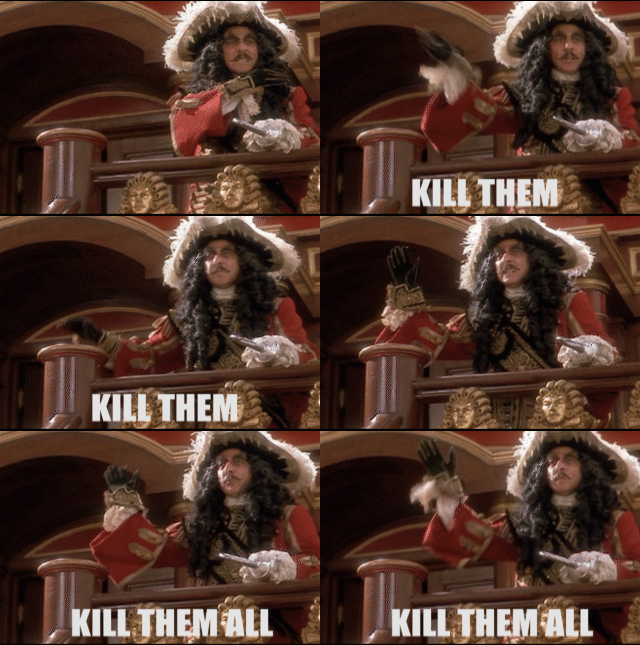
She was rather tall. She was tall. He was quite idiotic. He was idiotic. They were somewhat snazzy. They were snazzy. Why do you need those words? Kill ‘em.
Start/begin
This is a great example of fluff.
She started to run toward the shop. vs. She ran toward the shop.
He began scolding them for their performance. vs. He scolded them for their performance.
There are obviously uses for this word, like anything. He started the car. Begin your tests! But when you’re using it to slow the action and the pace of your narrative, then consider heavily if you need it. You probably don’t.
In order to/in an attempt to
Phrases that add unneeded complications, cumbersome wording…kill ‘em!
She bit down in an attempt to stop herself from screaming. vs. She bit down to stop herself from screaming.
Was able to
He was able to call. vs. He could call. OR He called.
This is one that isn’t inherently bad, but it can easily be overused and cutting it will help simplify your narrative.
Due to
Ugh. Are you trying to sound proper and stuffy? Because that’s a reason, I guess, to use this phrase…and yet it sounds like doodoo. (Yes. I’m an adult.) Rephrase. Use “Because of” or just avoid the need altogether.
We stopped due to traffic. vs. We stopped because of traffic. OR (Strength of narrative!) We stopped mid-highway. The parked cars went on beyond the curve of the road, out of sight.
Visibly/obviously/apparently/audibly
These are a sign of telling in your narrative when you should probably be showing.
She was visibly shaking. –> She shivered, hugging her upper arms. He was obviously tired. –> He yawned and tripped on his own feet as he crossed the room. They were apparently angry. –> They stomped and shouted, demanding attention. She screamed audibly. (Really?) –> She screamed.
Don’t tell your readers what emotion a character is feeling. Instead, give a few clues that they can see/hear/feel the emotion too.
While
This word has lots of legitimate uses. However, if you’re using it poorly, then your narrative reads like an Early Reader’s book, and you (unless that’s what you’re writing) probably don’t want that.
“Get it together,” he said while flipping them off. vs. “Get it together,” he said, flipping them off.
Turned
One of the classics. So overused, my friends. It’s needed on occasion, but not nearly as often as we use it. Just cut it out.
They turned toward her as they spoke. vs. They gave her their full attention as they spoke. OR They looked into her eyes. OR (Nothing. Readers don’t have to be updated on every little movement.)
Saw/looked/regarded
UGH. Regarded:Looked::Mentioned:Said
And, like “said,” many, many instances of these words can be nixed.
She saw them run for the hills. vs. They ran for the hills.
This can be tricky, I know, when you’re writing in limited-third or first POV. It’s tempting to put every action directly through your POV character’s filter. But resist that temptation! There are times when it’s appropriate, occasionally, but it can be overdone so easily.
I looked at her and said, “Please.” vs. I said,“ Please.” OR. I took her hand. “Please.”
This example sides with the breathing and the turning. It’s often an unneeded update on the tiny movements of the characters. And, again, sometimes you need that beat or that little detail in an intense moment, but not often.
I’m not here to tell you to cut all your dialogue tags (please don’t). I’m also going to the last person who insists you get rid of “said.” In fact, I’m in the “said is invisible” party of writing nerds and I think, if you’re going to use a standard tag, it should be “said” 90% of the time.
But aside from that, using as few dialogue tags as possible is a good thing. I’ll do a full post on this soon, but for now, be aware of how often you rely on these words in your dialogue and do your best not to overuse them. Use surrounding action and context to take some of the reliance off of these words.
To-Be in all its conjugated forms
If you’re using any of this list:
am, is, are, was, were, be, being, had been
Then check yo’self. Some tenses call for an auxiliary verb. Some types of sentence do, too, not doubt about it. But many don’t, and cutting to-be verbs when you can will help tighten your writing.
We were going to the store. vs. We went to the store.
Sounds were echoing through the chamber. vs. Sounds echoed through the chamber.
To-be verbs can also be an indicator of passive voice, though they aren’t always.
He was hit by the ball. vs. The ball hit him.
Last but not least, check all of your adverbs.
Chances are, if you’re using an adverb, you could be using a single strong verb instead and giving each sentence more punch.
He ran quickly. –> He sprinted. I hit him hard. –> I socked him. She spoke quietly. –> She whispered. They ran into each other fast. –> They crashed.
So what am I supposed to do about this?
Take it to heart. Try not to let these words take over your brain as you write. Once your manuscript is finished, try this method:
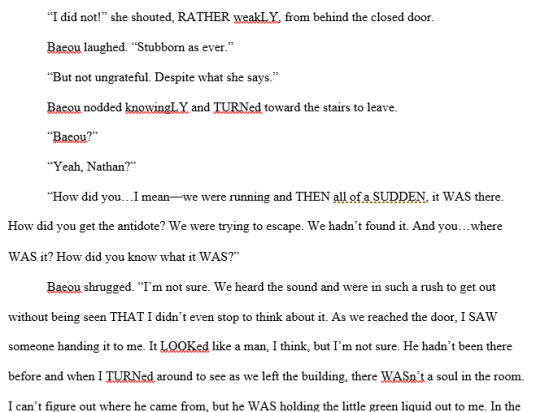
Use Find and Replace. Replace any and all of the aforementioned words in ALL-CAPS. Now, if you’ve paid attention to my advice in using emphasis, then those all-caps will really stick out as you’re reading over your work and you can decide at each instance whether your usage is appropriate, or if it needs to be rewritten. As I did to this very old draft of mine from my first NaNoWriMo (in which I used every single word on this list, I’m sure).
When I used this method with my most recent WIP, I was able to cut my word count from 105k to 93k without cutting any content whatsoever. It takes a lot of work and it’s pretty tedious but the results are amazing!
It wouldn’t be the English language without exceptions, would it?
Now, there is actually an important time for intentionally using any or all of the words on this list. You know when that is?
When it fits the character’s voice. – More on this in my next post!
Hey guys! As a writer myself, it’s hard to have a lot of resources for writing in one place. That’s why I decided to create this masterpost, and maybe make more if I find future resources. I hope you like it, and expect to see more masterposts like this in the future!
ZenPen: A minimalist writing website to keep you free of distractions and in the flow.
The Most Dangerous Writing App: A website where you have to keep typing or all of your writing will be lost. It helps you keep writing…kind of. You can choose between a time or word count limit!
Evernote: An online website where you can take notes and save the product to your laptop and/or smartphone!
Writer, the Internet Typewriter: It’s just you and your writing, and you can save your product on the website if you create an account.
Wordcounter: A website to help check your word and character count, and shows words you’re using frequently.
Monospace: An Android app for writing on the go when you feel the inspiration, but you don’t have your laptop on you!
For Productivity
Tide: An app that combines a pomodoro-esque timer with nature sounds and other noises! (Google Play / Apple Store)
ClearFocus: An Android app with a pomodoro-type time counter to let you concentrate easier and stay productive.
Forest: An app with a time counter to keep you focused and off your phone, and when you complete the time limit, a tree grows in your garden! (Google Play / Apple Store)
SelfControl: A Mac downloadable app that blocks you from distracting mail servers, websites, and other things!
So you have a set of characters ready for the curtain to rise and the story to begin. But how do they get along with each other? Do they even get along at all?
Character relationships are REALLY hard to do. But character webs have helped me keep track of how everybody relates to one another. They’re a way to visually connect characters to help you remember what they think of each other.
They end up looking something like this:
And honestly? They’re just as cool as they look. Let’s go through a quick rundown of how they work.



 willowfoot