so remember that worldbuilding website, notebook.ai, that was goin around and everyone was so excited, but it turned out you had to pay a (frankly outrageous) subscription to access any of the best tools?
There’s no one way to start writing a book. For some people, it’s enough to just jump in and start writing to see where the story takes them. If you’re not too keen on that idea, then here is oneprocess (as in, not theonlyprocess) that might help you move beyond your concept.
Concept ≠ Plot
Many writers mistake concept for plot, but they’re actually two very different things. A world where everyone grows up with superpowers is a concept; the plot is what you decide to write about within that concept – the specific characters and what happens to those characters; who your antagonist is and what conflict arises when that antagonist goes after what they want. All of these things contribute to your plot.
So first, define what it is you actually have at this particular point. Do you just have a concept? If so, you’ll need to take the necessary steps to develop that concept into a plot.
Concept >>> Plot
If you’ve decided that all you really have is a concept, then how do you take it and turn it into a plot? You brainstorm. All brainstorming really amounts to is expanding your ideas. All you’re doing is asking questions about the concept and delving deep into the answers.
The most simplistic way to start this process, especially if you’re struggling, is to ask one of two questions (or both, if applicable). These two questions: What could go wrong? What could go right?
Going back to my example about a world where everyone grows up with superpowers. If I were to ask the question “what could go wrong,” I’d end up with a whole list of possibilities.
The powers suddenly disappear
People start abusing their powers
Someone figures out how to steal powers
A hierarchy of strong vs. weak powers develops, creating superiority/inferiority dynamics
Someone is born without a superpower
There are many more possibilities I didn’t even think of here, but any one (or more) of these could become a plot. Choose one that sounds interesting, and then ask yourself “and then what?”
Say I choose: Someone figures out how to steal powers. Then what does that person do? Do they recruit people to do the dirty work for them? Do they work alone? Do they hoard these powers and barter them for other goods? Do they attempt to enslave people? Do they attempt to take control of institutions? What do they do?
Your goal is to take your ideas and turn them into actions taken by characters. People doing things. And each piece you add will usually lead into another. If you went with the idea that this character is stealing powers and essentially selling them for other goods, you’d have to ask yourself follow-up questions. First, who are they selling to? Why would anyone buy a new superpower if they already have one? What uses would they have for additional ones? What is the key demographic that this person is trying to reach? Secondly, what are they selling them in exchange for? Money? Favors? Souls? What is this character getting in return?
Now that you’ve examined potential actions that the character takes, you’ve also exposed potential new characters.
People they’re stealing from
People they’re bargaining with
People that try to police these crimes
People that try to copy this character’s process
At the beginning of this section, I talked about using “what could go right” as another optional jumping off point. This is a good path to follow if your concept is already really negative. For a concept where someone is killing people for some pointed reason, you might ask “what could go right” and explore ideas where the killer is caught and brought to justice.
The point of all this is to think about change as a means of taking your idea from concept to plot. A concept is static – it doesn’t move, evolve, or change. By developing a plot, you’re forcing the concept to be challenged in some way. If you think about it that way, you’ll be able to formulate conflicts, and the people that orchestrate and fight against those conflicts.
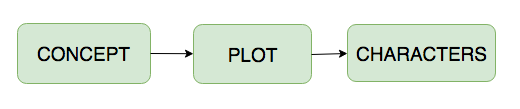
On that note, I think we’re ready to move onto the third piece of my graphic above.
Plot = Character Actions and Consequences
At this point, you have sketches for characters. You’ve got this nameless, faceless person that is stealing the powers, and all these other nameless, faceless people that I listed above. In essence, we have character concepts. And just like we turned our initial concept into a plot, we have to turn these character concepts into actual characters.
The basics are the easiest way to start. You figure out their name, their gender identity, their age, their appearance, some brief backstory and personality traits. I personally prefer the simplest questionnaire that I put together back in the early days because it hits on the poignant pieces of a character without overwhelming you with 100s of questions.
Now that you’ve given your character concepts names and faces and potential behaviors, you start to consider how one character’s view of the world inspires them to take certain actions, and you then think about how those actions affect your entire story.
We already kind of talked about the motives of the power thief in our example, but definitely delve deep here. On the surface, this character seems bad – stealing from people and then selling what they steal. But depending on what it is they’re getting in return, could we not argue that this character is a supernatural Robin Hood? Maybe instead of selling, they’re giving, and maybe the characters they’re stealing powers from are people that abuse and misuse their powers. Character motives can take a plot and turn it on its head, forcing you to reconceptualize everything. And that’s okay! That’s part of the process.
But separate from that idea, if we have a character concept of someone whose powers were stolen, and after developing their basic backstory, we discover that person’s name is Rose, and she has an especially close relationship with her brother. So when her powers are stolen, how does this affect her life? Was she using her powers to keep her brother alive and protected? What she using them to keep a roof over their heads? Was she using them as part of her job, as a means of providing? What happens to her life when her powers are stolen? And what will Rose do about it? Whatever Rose does will impact the story. If she does nothing to get her powers back, how does she solve her problems and does that make for a good story? If she does decide to act, then you’ve moved onto a new plot point to dive deeper into.
My point is, character concepts come from plots, but characters themselves often create plot, as their decisions and mistakes and successes create new outcomes. So if I could modify my original flow chart:
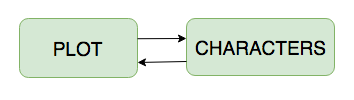
Before you develop something, you conceptualize it. You have a concept, then you make it a plot. You have concepts for characters, then you make them characters. And those characters end up driving your plot, to the point that this happens:
Plot inspires character. Character inspires plot. And it just keeps going around and around and around. Breaking it down into these pieces helps organize the process, but developing a story is rarely this neat and tidy. You’ll get ideas that don’t make sense, ideas that aren’t cohesive, characters you don’t need, characters that piss you off, problems you can’t solve, or plot points you’ve committed to that you no longer like…it will be messy. But it’s your mess, and the more you work on developing your own process, the more it’ll make sense to you. And it’ll become easier to know how to go about fixing it when something’s not right.
Have fun with this process! It’s supposed to be fun. When the pieces start to become clearer, you’re able to put them together in a rough outline. And once you have a rough outline, you can start writing, and really see it take shape.
People sometimes send me Asks wanting writing advice. I suck at it. I don’t really know how I do the writing, or how one should do the writing, or what one should do to get better at the writing. All I can ever think to say is “write a lot of stuff and you will get better at the writing.” Which is true, but hardly a bolt from the sky.
Well, as it turns out, I do have one piece of Legit Writing Advice, and I am going to share it with you, right now. If you were in any of my writing workshop groups at a con, you’ve heard this advice already.
Warning: you’re going to fucking hate it. But if you do it, you will thank me.
If you have a piece of fiction you’re serious about, something you might want to actually shop around, or just something you really are into and want to make it as good as you can…do NOT edit it.
Repeat. DO NOT EDIT.
REWRITE.
As in, print out the whole fucking thing and re-enter it, every word (or use two screens). Retype the whole thing. Recreate it from the ground up using your first draft as a template. Start with a blank page and re-enter every. single. word.
I hear you screaming. OH MY GOD THAT’S INSANE.
Yes. Yes, it is.
It is also the most powerful thing you will ever do for a piece of fiction that you are serious about.
Now, let’s get real. I don’t do this for most things. I don’t do it for my fanfiction. But if it’s something original, something I might like to get to a professional level – I do it. You absolutely COULD do it for fanfiction. It’s just up to you and how much time you want to sink into a piece.
You can edit, sure. But you WILL NOT get down to the level of change that needs to happen in a second draft. You will let things slide. Your eyes will miss things. You will say “eh, good enough.”
The first time I did this, on someone else’s advice, I was dubious. Within two pages, I was saying WHY HAVE I NOT BEEN DOING THIS ALL THE TIME. I was amazed at how much change was happening. By the time I got to the end, I had an entirely different novel than the one I’d started with. When you’re already re-entering every single word, it’s easy to make deep changes. You’ll reformat sentences, you’ll switch phrases around, you’ll massage your word choice. You’ll discover whole paragraphs that don’t need to be there at all because they became redundant. You’ll find dialogue exchanges that need reimagining. Whole plot points will suddenly be different, whole story arcs will reveal their flaws and get re-drawn.
You cannot get down to the fundamental level of change that’s required just by editing an existing document. You have to rebuild it if you really want your story to evolve. You will be AMAZED at the difference it will make.
It will take time. It will seem like a huge, Herculean task. I’m not saying it’s easy. It isn’t. But it is absolutely revolutionary.
Try it. I promise, you will see what I mean.
*PSA: Tipsy!Lori wrote this post. In case you couldn’t tell.
maybe i should try this with my comic scripts.
This advice is real.
I reblogged this earlier on kind of a “that sounds interesting. might work, might not, can’t see it being drastically different but whatever I should try.” kind of note
I’ve got a short story due today at 5, so I decided to do this and completely rewrite the first draft.
OH. MY GOD.
This is legitimate. It’s let me completely gut scenes I was unhappy with, rewrite them entirely differently and not feel any loyalty to what I used to have.
It’s taking a long time. It’s a commitment. But heck so is writing.
This is great. Do this. It’s amazing.
This is such good advice. I’ve done it a few times, and it completely transforms your work. It’s a time consuming process, but it’s absolutely worth the investment. I highly recommend this on things you truly care about. It’s incredible.
I was going to be like “this is ridiculous, what an unreasonable standard” and then go off in a huff to work on an article, and then I remembered that the way I write articles now is by doing an audio draft, and then basically rewriting the article entirely while listening to the audio draft… so… yeah. This is probably actually really good advice. >_>
a blinking cursor on an otherwise completely blank word document
red squiggles everywhere because your laptop doesn’t recognize any of the character names
an endless trek through thesaurus.com trying to figure out the word that’s on the tip of your tongue that you just can’t remember
typing a word, deleting it, 20 minutes pause while you try to come up with something better, then giving up and retyping the same word
doing a quick google for research purposes and then accidentally ending up 30 articles deep in wikipedia with a new found expertise on Polish trade practices during the 1800s
giving up halfway through the chapter and making PLACEHOLDERS IN ALL CAPS CUZ YOU CAN’T BE BOTHERED TO FIGURE THIS FUCKING PART OUT RIGHT NOW
deleting entire paragraphs
panicking and frantically hitting ctrl+z
an endless string of G’s because you passed out on your keyboard at 3 am
artists: aw man today was a slow day, i just did a few doodles and colored a sketch from yesterday
writers: never once in my life have a written
There is a specific and terrifying difference between “never were” monsters and “are not anymore” monsters
“The thing that was not a deer” implies a creature which mimics a deer but imperfectly and the details which are wrong are what makes it terrifying
“The thing that was not a deer anymore” on the other hand implies a thing that USED to be a deer before it was somehow mutated, possessed, parasitically controlled or reanimated improperly and what makes THAT terrifying is the details that are still right and recognizable poking out of all the wrong and horrible malformations.
hey I totally fucked up and forgot the 3rd type, which is “Is Not Anymore And Maybe Never Was” monsters
“The thing which was no longer a deer and maybe never was” implies a creature that, at first glance, completely appears to be a deer, but over time degrades very slowly until you realize (probably too late) that it is not a deer anymore, and had you seen it in this state first, you wouldn’t have recognized it as a deer at all, and there’s a decent chance that it was never actually a deer to begin with but only a very good mimic, and what makes this one scary is the slow change from everything being right to everything being wrong, happening slowly enough that you don’t even notice it until its too late, as well as the fact that something now so clearly not a deer could have fooled you to begin with.
And the fourth type, which is, “I dunno, but it sure ain’t a deer.” Which implies complete confusion about what the creature could be, to the point that even a person as comfortable in this world as someone who would use the word ain’t unironically is uncertain, which should horrify you to the deepest depths of your soul.
you ever start rereading your WIP to get in the mood and write more and you get so caught up that when you get to the end you’re like “bitch? where’s the rest?” and you realize you’re the bitch and you have to write it
look…………….. write as much shitty fic as you want. nobody can stop you. you’re learning constantly and it’s better to write hackneyed implausible ridiculousness than it is to not write at all out of fear of fucking up. you’re good
There was an experiment a professor did. I think it was pottery students. He did an experiment of “quality” vs “quantity”. One half of the class he told; you have to make as many pots as possible. Good pots, bad pots, shitty pots, whatever. The more pots you make, the higher your grade.
The other half of the class were told, “you can make only one pot”. But that pot had to be perfect. The quality had to be high; the highest quality pot would get the best mark.
But when it came to the grading, they noticed something weird.
All the best quality pots were in the ‘quantity’ group.
The guys who were literally churning out pots, trying to make as many as possible, not concentrating on the quality. But every pot they made, made them better at making pots. By the end of the month (I think it was a month) – they had some pretty awesome pots coming out, because they enjoying finding all the ways and all the things they could do to make all their pots. Where as the ‘quality’ guys had spent their time reading up on pots, and technique, and researching and planning; which was all great but they’d had no further practice at actually making pots.
The best way to get really good at something, the only way to be really good at something, is to make lots of shitty attempts at that thing several of which will fail. If all you create are perfect things then you won’t improve, because how can you improve on perfect?



 willowfoot